
Business Goals
ITZKXY enterprise networking and AI infrastructure support
A practical architecture for RAG question-answering applications using NVIDIA NIM, LlamaIndex Workflow, Chainlit, retrieval controls, and evaluation checkpoints.
View SolutionTesting and compatibility validation

A RAG question-answering application should not send every user message through retrieval. The source describes a workflow that combines NVIDIA NIM microservices, LlamaIndex connectors and Workflow events, and Chainlit to route work more deliberately. This approach is intended for applications that answer from internal data while also handling requests such as translation, email editing, code generation, and web search or summarization where appropriate.
A basic RAG application often runs a retrieval pipeline for every message. According to the source, this can consume unnecessary tokens and add latency when retrieved content is irrelevant to the request. The issue becomes more visible when users treat an internal knowledge assistant as a general-purpose assistant rather than a narrowly scoped document-search tool.
The source also reports that users of applications built for private internal data may want web search and summarization capabilities. Its described implementation used Perplexity's search API for that need. Whether an external search service is suitable depends on the organization’s data-handling requirements, permitted query content, and the applicable service documentation.
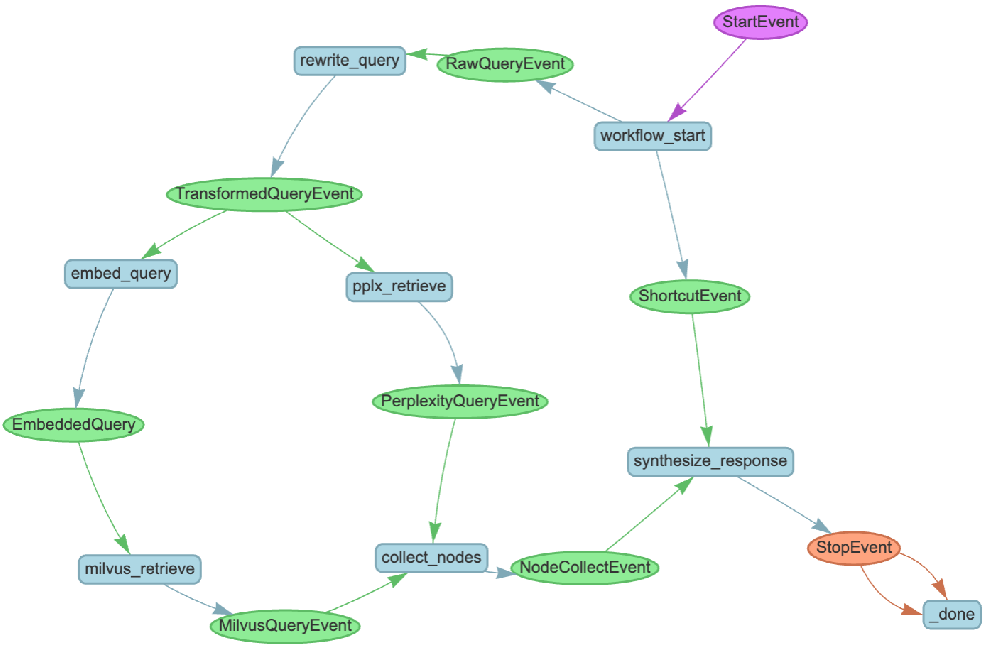
The proposed path is an event-driven workflow in which request handling is selected before retrieval is invoked. LlamaIndex Workflow events provide a step-based mechanism for controlling execution, while LlamaIndex can retain functions such as vector stores and retrievers when retrieval is required.
An event-driven workflow adds routing decisions and more execution paths, so teams need clear rules for when internal retrieval, general LLM processing, and external search are permitted. Broadening an assistant beyond private knowledge retrieval can improve task coverage, but it also requires separate controls for external queries and response review.
The source describes LlamaIndex capabilities including connectors, document parsing, indexing, query engines, prompt engineering, APIs and SDKs, caching, parallel processing, and extensions. It does not establish specific throughput, latency, retrieval accuracy, model compatibility, security controls, or deployment requirements. Confirm these points in dated official documentation, the complete implementation configuration, and project testing.
Retrieval can be bypassed when a request does not require indexed knowledge, such as a translation, email-editing, or code-writing task. The routing logic should be tested against real request patterns so that knowledge questions still reach the appropriate retriever.
The source describes both internal-data access and a Perplexity search API integration. A production design must verify which data can leave internal systems, whether external queries are approved, and how citations, summaries, and user-facing traces should be handled.
The described solution uses event-driven LlamaIndex Workflow events to make RAG one path within a broader LLM application rather than the default for every message. Start with data ingestion, indexing, and request routing; then validate retrieval relevance, non-RAG task handling, external-search controls, and operational behavior through a project-specific test.
After reviewing Building a RAG Question-Answering Workflow with NVIDIA NIM, continue with NVIDIA products and networking solutions for related evaluation paths.
Testing and compatibility validation
ITZKXY enterprise networking and AI infrastructure support
Technical service and delivery support
Testing and compatibility validation
Project delivery and optimization support
Testing and compatibility validation
Solution planning and implementation support
Compatibility validation and project risk control
Testing and compatibility validation
Product selection and project support
ITZKXY enterprise networking and AI infrastructure support
Compatibility validation and project risk control
Product selection and project support
Product selection and project support
Testing and compatibility validation

 WeChat
 Inquiry
WeChat
WeChat Inquiry
 Profile
Company Profile
Profile
Company Profile