
Business Goals
ITZKXY enterprise networking and AI infrastructure support
Assess a BlueField DPU-based Supermicro JBOF approach for AI and HPC storage, including deployment choices, performance claims, validation steps, and limits.
View SolutionTesting and compatibility validation

For AI training, RAG inference, and HPC environments that need high-bandwidth or low-latency access to large data sets, a BlueField DPU-based JBOF can reduce the roles traditionally assigned to a separate storage-server CPU, NIC, memory, and management components. The source describes a Supermicro JBOF design using NVIDIA BlueField DPU controllers to connect SSDs, present storage services, and accelerate network, storage, security, and management functions. Whether it is the right design depends on the storage protocol, high-availability model, SSD configuration, software stack, and measured workload behavior.
AI model training may require high-bandwidth network access to PB-scale data, while RAG inference can require low-latency access to storage at the scale of hundreds of TB. Image and video training, indexing, vector databases, and metadata-heavy search can further increase storage demands. The source positions object storage as a common architectural option for large data volumes, while noting that file and block presentation are also possible in the BlueField-based JBOF design.
Instead of relying on a conventional storage server with a discrete CPU, memory, NIC, and management hardware, the described approach uses a DPU to run storage software, attach to the network, manage SSDs, and provide remote-management and security offload capabilities. This can shorten the data path between SSDs and high-speed network ports by reducing processing through an external CPU and repeated traversal of separate PCIe buses.
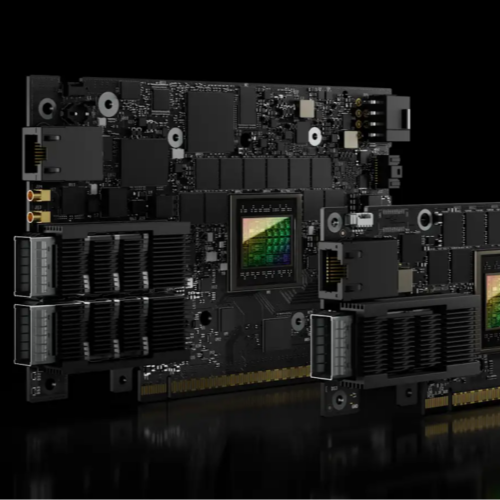
The source describes NVIDIA BlueField as a DPU optimized to offload and accelerate networking, storage, security, and management. Its controller card supports up to 400 Gb/s of network traffic and can accelerate NVMe over Fabrics (NVMe-oF) and other RDMA-based storage traffic. BlueField acts as a PCIe root complex for SSD management, while its Arm cores can run storage software.
These functions do not by themselves establish application-level performance. Buyers should confirm the supported DPU model, network ports, PCIe topology, SSD compatibility, storage software, and feature configuration in dated official documentation and the complete system BOM.
The referenced 2RU Supermicro JBOF supports either 36 E3.S SSDs or 24 U.2 SSDs. The source states raw capacity of up to 1.44 PB, with up to 2 PB when using newer 60-TB SSDs. Each controller canister can hold up to two NVIDIA BlueField-3 DPUs and one NVIDIA GPU.
| Design choice | Potential role described by the source | Evaluation point |
|---|---|---|
| Two controller canisters | Active-active or active-passive high availability within one JBOF | Verify failover behavior, quorum design, recovery time, and software support. |
| One controller canister | Higher efficiency for cloud storage designs that manage redundancy and failover in software across multiple JBOFs | Validate fault domains, replication policy, and capacity behavior during failures. |
| Up to 800 Gb/s per JBOF | Network throughput intended for AI training and HPC demand | Confirm usable throughput for the selected port, DPU, protocol, and workload configuration. |
The source reports Supermicro testing in which a storage workload with one BlueField DPU saturated a 400-Gb/s network connection. It also reports 86 μs latency for 4 KB random reads on the new JBOF, compared with 100 μs for a conventional x86-based JBOF, a 13% reduction. These are source-reported test results, not universal deployment outcomes.
The source further states that replacing CPU, memory, NIC, and BMC functions with one DPU card can save up to 50% of non-SSD subsystem power, or 10% to 15% of total JBOF power including SSDs. Actual power, latency, and throughput must be verified through a project test using the intended SSD population, storage software, traffic profile, and availability configuration.
No. The source states that BlueField Arm cores can run storage software that presents the JBOF as block, file, or object storage. The appropriate option depends on the application, data services, client protocols, and operational model. Confirm the selected storage stack's compatibility with the planned hardware configuration.
Two canisters are described for active-active or active-passive high availability within a JBOF. One canister may be more efficient where cloud storage software provides redundancy and failover across multiple JBOFs. The decision requires validation of software resilience, failure handling, power goals, and service-level requirements.
A BlueField DPU-based Supermicro JBOF is a storage architecture option for environments seeking to combine dense flash storage with high-speed network access and DPU offload. Its value should be evaluated as a complete system: workload profile, protocol, SSD topology, storage software, high-availability design, and measured behavior under normal and failure conditions determine the practical outcome.
After reviewing NVIDIA BlueField DPU Architecture for Supermicro JBOF Storage, continue with NVIDIA products and networking solutions for related evaluation paths.
Testing and compatibility validation
ITZKXY enterprise networking and AI infrastructure support
Technical service and delivery support
Testing and compatibility validation
Project delivery and optimization support
Testing and compatibility validation
Solution planning and implementation support
Compatibility validation and project risk control
Testing and compatibility validation
Product selection and project support
ITZKXY enterprise networking and AI infrastructure support
Compatibility validation and project risk control
Product selection and project support
Product selection and project support
Testing and compatibility validation

 WeChat
 Inquiry
WeChat
WeChat Inquiry
 Profile
Company Profile
Profile
Company Profile