
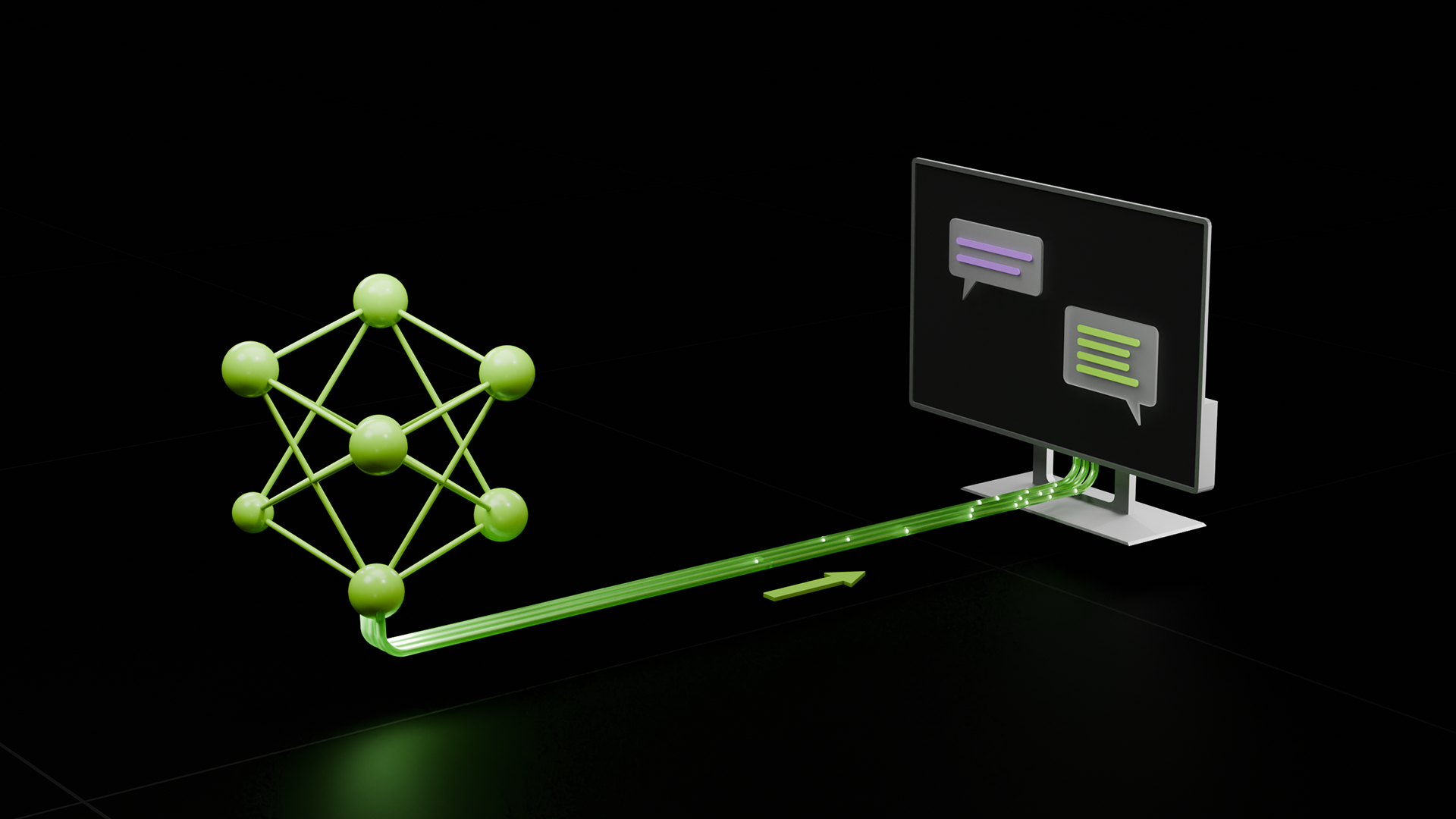
NVIDIA TensorRT-LLM chunked prefill is designed for LLM inference services where long input prompts can delay token generation for active requests. By processing a prompt in smaller chunks instead of one uninterrupted prefill operation, the system can better interleave prefill work with decoding work. This approach can improve GPU utilization and helps teams balance time to first token (TTFT), query completion time, throughput, context length, and memory behavior.
The inference problem: prefill and decode use GPUs differently
An LLM request typically has two compute phases. During prefill, the inference service processes input tokens, calculates the KV cache, and produces the first output token. This phase is compute-intensive and can use the GPU's parallel processing capacity effectively.
During decode, the service generates output tokens one at a time and updates the intermediate state established during prefill. Because the substantial input processing has already occurred, decode is less compute-intensive than prefill.
TensorRT-LLM supports dynamic batching, so multiple requests can be processed in parallel and prefill can coexist with decode work. However, a large prefill request can still postpone decode progress for requests already in flight. For interactive services, that delay can affect perceived responsiveness and the time required to complete a query.
Architecture path: divide prefill into schedulable chunks
With chunked prefill, input tokens are divided into smaller units. Rather than allowing prefill to monopolize an iteration, the service can schedule prefill chunks alongside decode tokens. The intended result is a more balanced mix of GPU work: long-context requests continue to advance while existing generation requests retain opportunities to decode.
This architecture is relevant where a service receives variable prompt lengths, serves concurrent users, or must accommodate long contexts without allowing a single request to dominate scheduling. The source also states that memory use depends on the number of tokens processed in each iteration. Processing prefill in chunks can therefore decouple memory consumption from the full incoming context length, allowing larger contexts without increasing memory requirements solely because the full prompt is long.
Choosing chunk size requires an explicit service tradeoff
Chunk size affects both interactivity and aggregate service behavior. Larger chunks reduce the number of iterations required to process a prefill sequence and can reduce TTFT. The tradeoff described in the source is that larger chunks may increase the time required to complete decode work already under way, increase overall query completion time, and reduce output tokens per second (TPS).
Teams should therefore avoid treating chunk size as a universal performance setting. Start by defining the primary service objective:
- Prioritize TTFT when users need fast acknowledgement of a submitted prompt.
- Prioritize steady decode progress when long-running generations and concurrent sessions must remain responsive.
- Evaluate long-context behavior using representative prompt-length distributions rather than only short test prompts.
- Measure TTFT, end-to-end completion time, TPS, concurrency behavior, GPU utilization, and memory use together.
TensorRT-LLM provides dynamic chunk-size adjustment and uses GPU utilization metrics to provide recommendations, according to the source. The resulting choice should still be validated against the actual model, hardware, request mix, and latency objectives of the deployment.
Implementation checkpoints for TensorRT-LLM deployment
- Characterize production-like traffic, including input lengths, output lengths, concurrency, and latency targets.
- Enable and configure chunked prefill in the TensorRT-LLM deployment path appropriate to the selected release.
- Run controlled tests across chunk-size settings and compare TTFT, completion time, TPS, GPU utilization, and memory behavior.
- Test mixed workloads, especially long prefills arriving while existing requests are decoding.
- Set operational thresholds and retest after changes to the model, GPU configuration, batching policy, or workload profile.
The source further describes a configuration benefit: earlier engine-building workflows required developers to specify a maximum input sequence length for activation-buffer calculation. Sizing for the expected worst case could use GPU memory inefficiently. With dynamic prefill chunk-size adjustment, activation-buffer size is determined by the configured chunk size instead of requiring manual maximum-input-length configuration.
FAQ
When is chunked prefill most suitable?
It is most relevant when an inference service handles long or highly variable prompts alongside active decoding requests. It can help reduce prefill bottlenecks by enabling more parallel progress between the two phases. Whether it improves a specific service depends on workload characteristics and must be verified through project testing.
Does a larger prefill chunk always improve inference performance?
No. Larger chunks can reduce the iterations needed for prefill and may lower TTFT, but the source identifies a tradeoff with decode completion time, total query completion time, and TPS. Select a setting based on measured service-level objectives rather than a single metric.
Conclusion
TensorRT-LLM chunked prefill provides a scheduling approach for balancing compute-intensive prompt processing with lower-intensity token decoding. Its value is strongest where long context, concurrency, and interactive latency compete for GPU resources. Confirm supported configuration details and behavior in dated NVIDIA TensorRT-LLM documentation, then validate the selected settings using a representative deployment test.
After reviewing TensorRT-LLM Chunked Prefill for More Balanced LLM Inference, continue with related solutions for related evaluation paths.

 WeChat
 Profile