
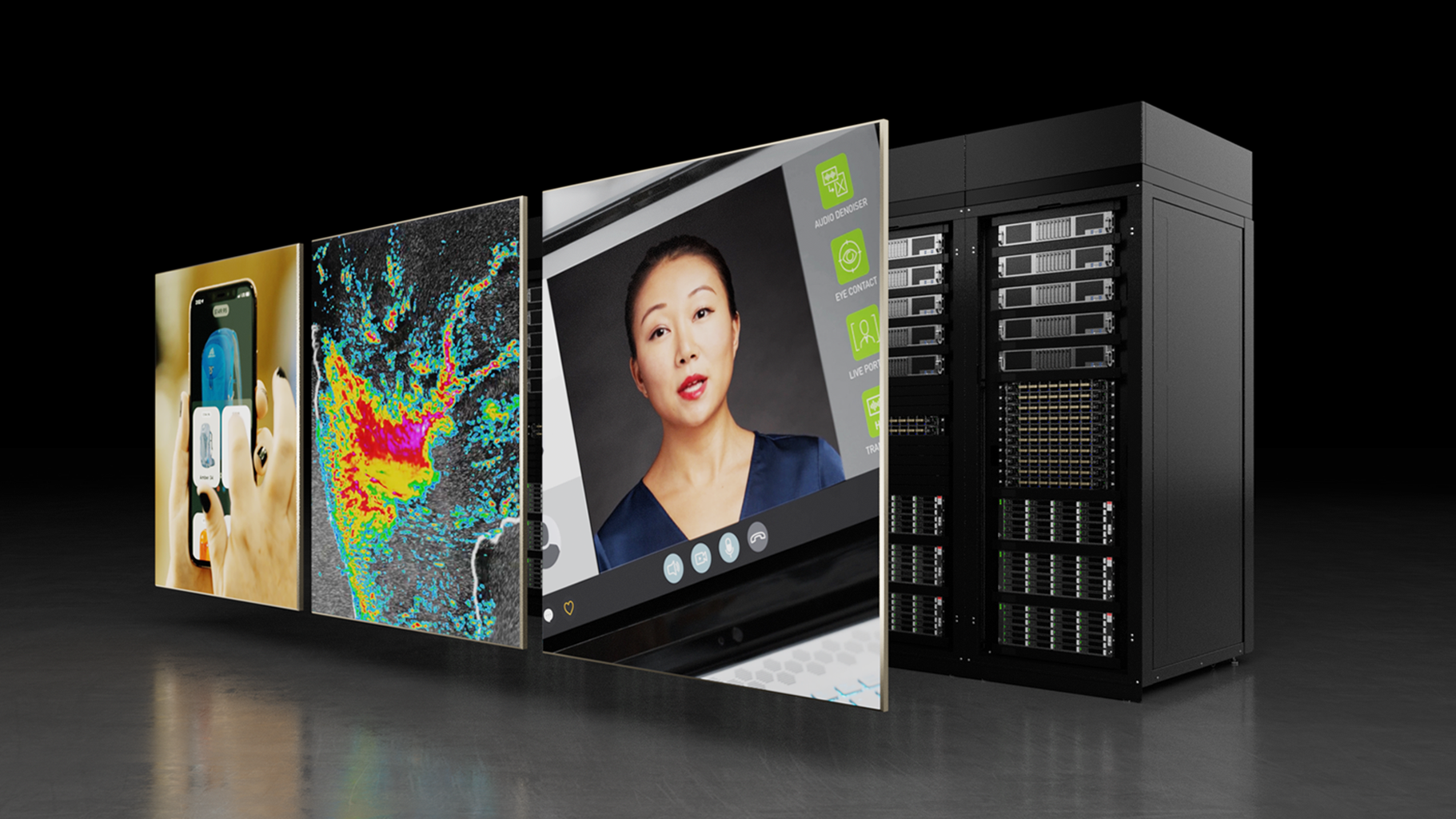
NVIDIA NIM 1.4 is presented in the source record as an inference-microservices update intended to simplify deployment of generative AI models while incorporating performance improvements from NVIDIA TensorRT-LLM, CUDA, and related accelerated-computing software. The reported up-to-2.4x inference-speed improvement is workload-specific, so teams should treat it as an evaluation input rather than a general production result. The supplied record describes a planned early-December release, despite its later publication date; confirm the release status, supported models, hardware matrix, and image versions in dated NVIDIA documentation before scheduling a deployment.
Scenario: production inference with operational consistency
Organizations building generative AI applications commonly need responsive model serving, sustained throughput, and a repeatable way to deploy and update inference software. The source describes NVIDIA NIM as production-oriented microservice containers for AI model inference, with preconfigured software intended to reduce manual setup.
This approach may suit teams that want a containerized inference layer and need to limit the engineering effort associated with assembling, tuning, and maintaining individual inference components. It is particularly relevant where application behavior depends on prompt-response latency, concurrent request handling, or long-context workloads. It does not by itself establish that a model, hardware platform, orchestration environment, or workload is supported for a specific project.
Architecture path described by the source: NVIDIA NIM 1.4 Inference Deployment: Evaluation and Architecture Path
The source positions NIM around multiple LLM inference engines, including NVIDIA TensorRT-LLM. It states that NIM releases integrate improvements in kernel optimization, memory management, scheduling, runtime heuristics, and memory allocation. It also states that NIM benefits from updates to NVIDIA TensorRT and NVIDIA CUDA through updated microservice containers.
- Choose the model-serving target. Identify the required model, prompt length, response length, concurrency profile, and latency objective before selecting an image or infrastructure configuration.
- Map the runtime to the accelerator environment. Validate the exact GPU configuration, driver, container-runtime requirements, and software compatibility against dated official documentation and the complete deployment bill of materials.
- Deploy the NIM microservice layer. The source describes a consistent single-command deployment experience, but the exact command, registry access, configuration parameters, and operational prerequisites must be verified for the selected NIM release.
- Connect the application and observe service behavior. Test request routing, failure handling, resource limits, logging, monitoring, and scaling behavior in the target environment.
What the reported performance result means
The source attributes improvements in NIM 1.4 to better kernel efficiency, runtime heuristics, and memory allocation. It reports up to 2.4x higher inference speed relative to NIM 1.2. Its throughput examples use Llama 3.1 70B on two H200-SXM GPUs with 8K input tokens and 256 output tokens, and Llama 3.1 8B on one H100-SXM GPU with 30K input tokens and 256 output tokens. A second cited comparison uses Llama 3.1 8B on one H100-SXM system with 30K input tokens and 256 output tokens.
These conditions matter. Performance can change with the model, GPU type and count, input and output token lengths, batching policy, concurrency, request distribution, and service-level objective. The record does not provide a complete benchmark methodology, latency percentiles, cost data, capacity figures, or results for other configurations. Teams should reproduce representative tests before using the stated uplift for capacity planning or procurement decisions.
Implementation checkpoints and risks
- Baseline first: Measure the existing serving stack with representative prompts and realistic concurrency so any change can be evaluated against a known result.
- Test long-context behavior: The cited examples include 8K and 30K input-token conditions, but project prompts, output limits, and multi-turn usage may differ materially.
- Validate update control: The source says updated containers can deliver software improvements without manual software updates. Establish image-version pinning, change approval, rollback, and regression-testing procedures before adopting an update path.
- Separate throughput from user experience: Higher throughput does not establish acceptable time-to-first-token, end-to-end latency, output quality, or availability for a particular application.
- Confirm operational dependencies: Security controls, model access, networking, storage, observability, and orchestration requirements are not specified in the source and require project-level design review.
FAQ
Does the reported 2.4x improvement apply to every NVIDIA NIM workload?
No. The source reports an improvement of up to 2.4x and cites specific Llama 3.1, H100-SXM, H200-SXM, and token-length test conditions. It does not establish equivalent results for all models, GPU configurations, prompt sizes, or traffic patterns. Validate performance with a project-specific test plan.
Can a team assume that NIM updates require no operational work?
No. The source describes updated NIM microservice containers as a way to integrate improvements and reduce manual configuration. It does not remove the need to validate compatibility, performance, security controls, version management, rollback procedures, and application behavior in the target environment.
Conclusion
The source presents NVIDIA NIM 1.4 as a container-based inference path that incorporates accelerated-computing improvements and reports meaningful gains in selected tests. The decision should rest on a controlled evaluation of the exact NIM version, model, accelerator configuration, token profile, and production operating requirements, verified against dated official NVIDIA documentation.
After reviewing NVIDIA NIM 1.4 Inference Deployment: Evaluation and Architecture Path, continue with NVIDIA products and networking solutions for related evaluation paths.

 WeChat
 Profile