
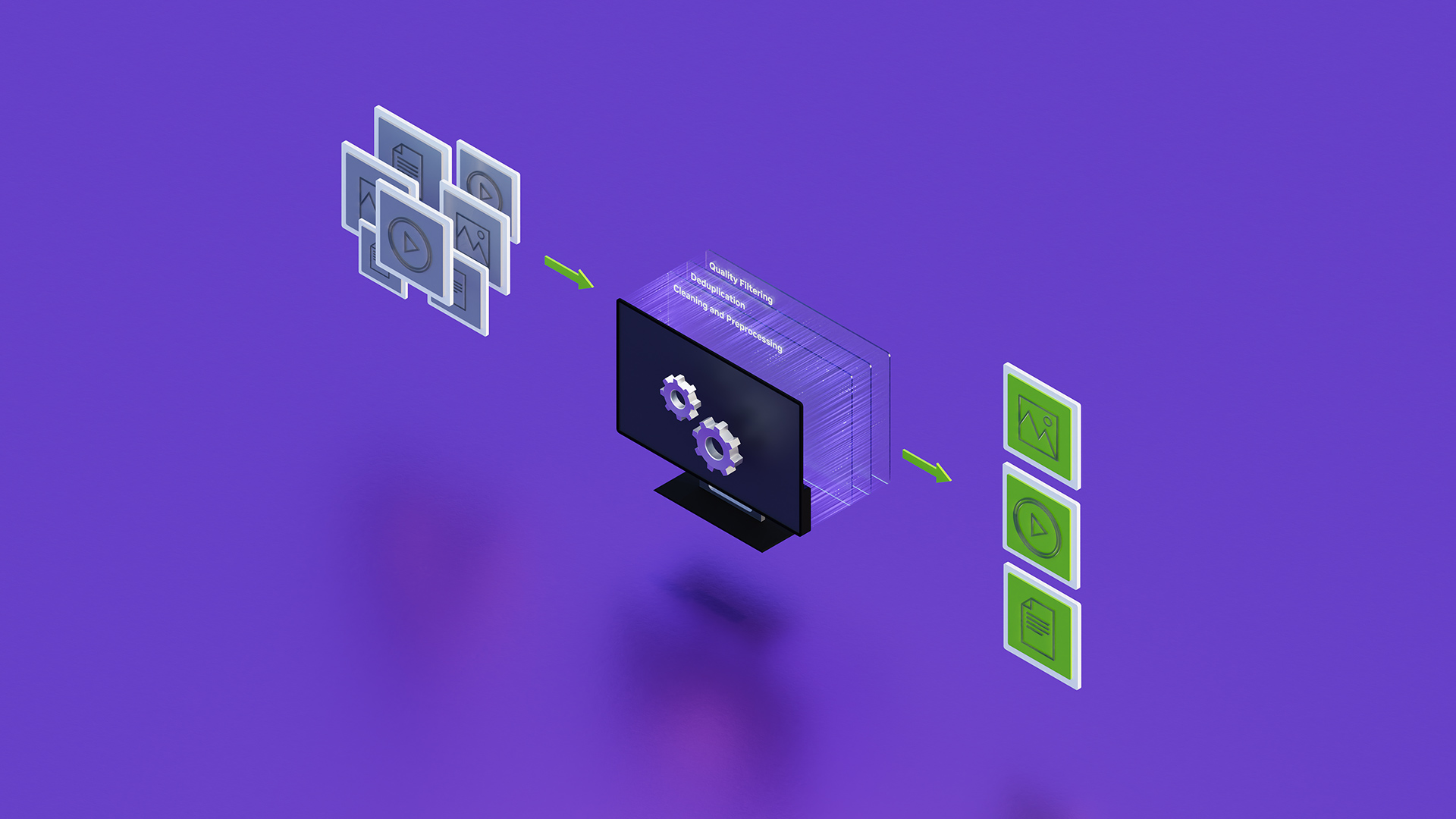
High-quality training data is a practical prerequisite for building and customizing accurate LLMs. NVIDIA NeMo Curator is presented in the source as a tool for constructing a data curation workflow that prepares large text corpora through cleaning, filtering, deduplication, privacy editing, classification, contamination checks, and dataset mixing. Its value depends on the data source, target language, model objective, compute capacity, and validation process rather than on any single processing step.
The data problem LLM teams need to address
LLM training and customization can be constrained by poor-quality or insufficient data. Web-crawled and other large datasets may contain malformed text, duplicate documents, personal identifiable information (PII), low-value boilerplate, harmful content, and material that overlaps with downstream evaluation sets. Training directly on such data can increase processing time and reduce the usefulness of the resulting model.
The source describes data curation as a staged process. Data may first be downloaded from public collections, specialized sources, or private on-premise datasets, then extracted from compressed formats such as .warc.gz, tar.gz, or zip into formats such as JSONL or Parquet. The correct format, storage design, and extraction approach must be assessed against the scale and operating environment of each project.
Capabilities described for the preprocessing workflow
A workflow built with NeMo Curator can begin with Unicode repair and language identification. These steps help address character-encoding errors and separate multilingual corpora when a team needs language-specific curation. Language separation also matters because heuristic rules and model-based quality classifiers may need to be selected or evaluated per language.
- Heuristic filtering: rules based on document length, repeated patterns, punctuation distribution, structural quality, template strings, and n-gram repetition.
- Exact deduplication: hash-based grouping to retain one copy of identical documents.
- Fuzzy deduplication: MinHash, locality-sensitive hashing, and Jaccard similarity to identify near-duplicate content.
- Semantic deduplication: embeddings, k-means clustering, and cosine similarity to identify conceptually similar documents.
- Model-based quality filtering: approaches ranging from n-gram classifiers such as fastText to BERT-style classifiers, LLMs, and reward models.
- PII editing and classification: removal, masking, or replacement of sensitive information, plus domain or safety-related classification at distributed scale.
The source recommends a cascading filtering approach for more transparent quality control. For large pretraining corpora, a lightweight model can support initial filtering while a more advanced model is reserved for final assessment. This tradeoff should be tested with representative project data, since more sophisticated quality models can require substantially more compute.
Where this approach is most suitable
This workflow is suited to teams preparing large-scale pretraining data, fine-tuning datasets, multilingual corpora, or domain-specific datasets where content quality, duplication, privacy, and evaluation integrity need structured treatment. Distributed data classification can be relevant when inference over very large corpora becomes computationally intensive, because the source describes splitting data across multiple GPU nodes.
It can also support preparation of synthetic data. The source outlines a generation, critique, and filtering sequence in which externally generated examples are evaluated and then further deduplicated or edited for PII. Synthetic data may help where real data is scarce, sensitive, or difficult to obtain, including low-resource languages and specialized domains.
Evaluation path and operational limits
- Define the model purpose, target languages, accepted data sources, and downstream evaluation tasks.
- Profile source data for encoding defects, language mix, duplicates, PII, harmful content, and format consistency.
- Apply cleaning and filters in stages, recording retained and removed samples for review.
- Compare exact, fuzzy, and semantic deduplication thresholds against diversity and quality requirements.
- Run task decontamination checks against evaluation data before reporting model results.
- Validate the curated dataset through project-specific model training and evaluation.
Data curation does not itself guarantee model accuracy, safety, privacy compliance, or performance. Semantic similarity thresholds, PII detection coverage, classifier behavior, local-language quality, and the suitability of synthetic data require validation against dated official product documentation, a complete implementation design, and project testing. Synthetic data can contain hallucinated or distributionally mismatched information, which may harm practical results when it does not represent the target use case.
FAQ
Which deduplication method should an LLM team use?
Exact deduplication is efficient for identical files or documents. Fuzzy deduplication is intended for near copies and partially overlapping text, while semantic deduplication targets paraphrased, translated, or conceptually similar material. A project may need more than one method, with thresholds evaluated against its desired dataset diversity and compute budget.
Can synthetic data replace real training data?
Not automatically. The source identifies synthetic data as useful when real data is scarce, sensitive, or unavailable, but it also notes risks from hallucinations and mismatch between generated and target data distributions. Teams should evaluate synthetic examples for quality, relevance, duplication, privacy, and downstream task performance before using them at scale.
Conclusion
NVIDIA NeMo Curator is described as a framework for organizing LLM data preprocessing from raw collection through final dataset assembly. The appropriate workflow is a measured combination of cleaning, filtering, deduplication, privacy handling, classification, and validation tailored to the model, language, data source, and operational constraints.
After reviewing LLM Data Preprocessing with NVIDIA NeMo Curator, continue with NVIDIA products and networking solutions for related evaluation paths.

 WeChat
 Profile