
For the TensorRT-LLM scenarios described in the source, FP8 is the preferred low-precision option when a Hopper-based deployment can use it and accuracy retention is a primary requirement. The source reports that FP8 preserved accuracy better than the tested INT8 SmoothQuant and INT8 weight-only plus INT8 KV-cache approaches, while also delivering the highest reported acceleration among those options. These results are workload- and configuration-dependent, so they should guide an evaluation plan rather than substitute for project validation.
What FP8 and INT8 Change in TensorRT-LLM
Post-training quantization (PTQ) reduces the precision used by selected inference operations. In the Transformer path discussed in the source, the relevant areas include four GEMM operations, multi-head attention, and optional KV-cache quantization. Quantization requires scaling factors for the red and blue GEMM paths and for an 8-bit KV cache. The cited analysis treats FMHA scaling as 1 for part of its comparison, while noting that TensorRT-LLM also implements non-unit scaling for improved accuracy.
On NVIDIA Hopper architecture, the source identifies two FP8 formats, E5M2 and E4M3, and states that TensorRT-LLM supports E4M3 in this context. FP8 can reduce data movement relative to FP16 or FP32 inputs and enables 8-bit GEMM execution on Tensor Cores. The source also states that FP8 is supported by Tensor Cores rather than CUDA cores.
Accuracy and Throughput Tradeoffs
In the MMLU-based evaluation reported by the source, the pure FP8 configuration retained accuracy more effectively than the tested INT8 SmoothQuant and INT8 weight-only with INT8 KV-cache configurations. FP8 versus FP16 was reported to provide approximately 1.5 to 1.7 times acceleration in the cited tests. Other tested low-precision methods also accelerated inference, but were reported to fall behind FP8 in that comparison.
The source further reports that FP8 FMHA can retain accuracy well when enabled with FP8 GEMM and KV cache. Its performance effect is most relevant to the context phase and first-token processing, where batch GEMM is computationally intensive. For a tested Llama2 7B configuration on an unspecified GPU model, the reported benefit of FP8 FMHA became more apparent as input sequence length increased. Do not treat these figures as a general performance commitment: model architecture, sequence lengths, batch size, engine settings, GPU model, software version, and serving stack must all be tested.
Attention and KV-Cache Considerations
FP8 and INT8 differ materially across attention phases. For fused multi-head attention (FMHA) during context processing, the source says FP8 Tensor Core batch GEMM can be used while softmax remains in FP32 because it is an accumulation operation. An FP8 output can feed the following FP8 projection GEMM, avoiding an additional quantization step. The source describes INT8 FMHA as having a substantial accuracy decline in its experiments, whereas FP8 was more robust.
During generation, masked multi-head attention (MMHA) uses GEMM shapes that are less compute-intensive, so changing that computation to FP8 may provide limited benefit. FP8 KV-cache storage can still reduce memory use. The source attributes faster FP8 KV-cache behavior than INT8 KV-cache on Hopper to different conversion and execution behavior, but this conclusion should be confirmed with profiling on the target engine and workload.
Practical ModelOpt and TensorRT-LLM Evaluation Path
- Start with a known FP16 baseline and define representative prompts, context lengths, batch sizes, and acceptance metrics.
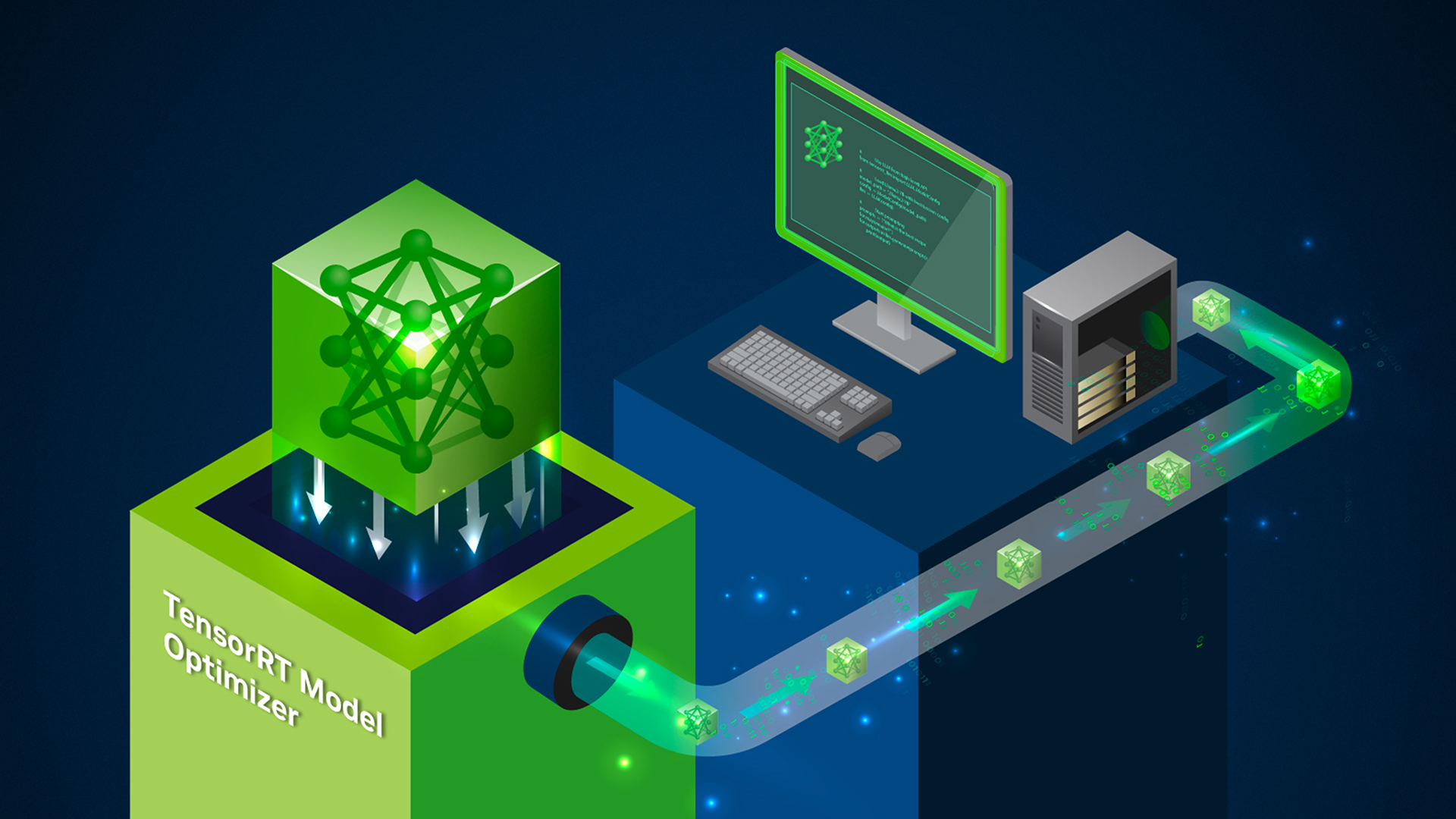
- Use NVIDIA TensorRT Model Optimizer, referred to in the source as ModelOpt, to calibrate the PyTorch model and calculate quantization parameters.
- Generate the model configuration and associated weight files, then build the TensorRT-LLM engine from that configuration.
- Evaluate task quality across representative datasets. The source uses MMLU, but production validation should also cover the target domain and failure cases.
- Measure prefilling and generation separately, including latency, throughput, memory use, and KV-cache behavior.
The source notes that tensor output registration and a debug model can be used to inspect intermediate values. If GEMM outputs are incorrect, it recommends checking weight-channel consistency across downloaded model variants. For attention issues, inspect the selected attention plugin parameters.
FAQ
Should every TensorRT-LLM deployment use FP8?
No. FP8 depends on compatible hardware and a validated software path. It is a strong candidate for the Hopper-focused conditions described in the source, but teams must verify supported precision formats, TensorRT-LLM options, model compatibility, and quality targets in dated NVIDIA documentation and their own test environment.
Is INT8 unsuitable for TensorRT-LLM inference?
No. INT8 can still be appropriate where hardware support, memory goals, model behavior, or existing deployment constraints favor it. The source only shows that specific INT8 approaches had weaker accuracy retention than pure FP8 in its reported comparisons. A complete decision requires the exact model, calibration data, KV-cache setting, and serving workload.
Conclusion
The source supports FP8 as the leading option among its tested TensorRT-LLM low-precision configurations, particularly for Hopper-based GEMM, context-phase FMHA, and FP8 KV-cache use. Treat that conclusion as a starting point: build comparable FP16, FP8, and INT8 engines, validate task quality, and profile the production-shaped workload before selecting a precision strategy.
After reviewing TensorRT-LLM FP8 vs INT8: Accuracy, Speed, and Evaluation, continue with buyer selection questions for related evaluation paths.

 WeChat
 Profile