
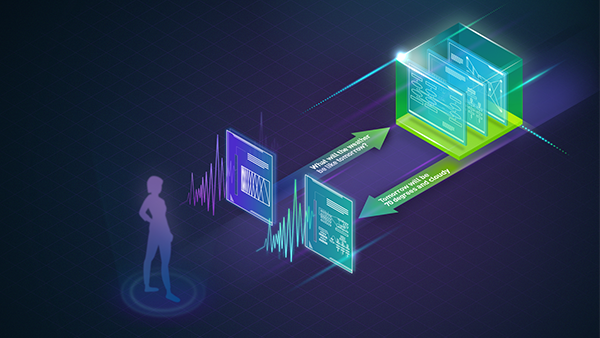
This automated audio captioning (AAC) approach is designed to produce natural-language descriptions from audio by combining multiple audio encoders with a multi-agent text-generation workflow. The source describes a research-oriented architecture rather than a packaged commercial product. It may be relevant to teams evaluating AI systems that need to interpret acoustic scenes and events, but model versions, deployment requirements, licensing, supported languages, and reproducible performance must be confirmed through the applicable technical documentation and project testing.
The audio-to-text problem addressed
AAC converts an audio input into a textual description. Because the input is sound while the output is natural language, the described system uses an audio encoder to extract feature vectors and a decoder to generate captions. The intended objective is not simply transcription of spoken words; it is to describe relevant acoustic content in a coherent sentence.
The source positions AAC as useful for systems that must interpret their surrounding acoustic environment. It also notes that the DCASE community has held annual AAC competitions since 2020, reflecting an active research area with evaluation practices that may differ from a production deployment's requirements.
Capabilities described in the architecture
The reported design extends a conventional encoder-decoder workflow with complementary models and post-processing stages.
- Multi-encoder fusion: BEATs and ConvNeXt are used as pretrained audio encoders to create complementary audio representations.
- Multi-layer aggregation: Outputs from different encoder layers are aggregated to provide the decoder with information at different levels of detail.
- Candidate-caption generation: The pipeline produces multiple possible captions rather than relying on one initial output.
- CLAP-based filtering: A Contrastive Language-Audio Pretraining (CLAP) model filters lower-relevance candidates; the source states that this reduces the candidate pool by half.
- Hybrid reranking and LLM summarization: Remaining candidates are reranked, then an LLM uses a task-activation prompt to consolidate selected descriptions into one final caption.
This combination treats audio encoders, ranking functions, and the LLM as cooperating agents with different roles. Its practical tradeoff is additional inference complexity: more encoders and several candidate-processing stages can improve coverage of audio features, but they also require teams to assess latency, GPU capacity, orchestration, failure handling, and output consistency.
Suitable evaluation scenarios
The approach is most relevant when an application needs descriptive captions for complex audio rather than basic speech recognition alone. Potential evaluation scenarios include acoustic-scene understanding, sound-event description, and multimodal workflows where caption text is passed to downstream text agents.
For projects with strict response-time limits, a multi-stage workflow should be compared against a simpler single-encoder or single-decoder baseline. For projects in which the final text informs a safety, compliance, or operational decision, human review and task-specific validation should be considered because the source does not establish error rates by sound class, language, environment, or deployment condition.
How to assess the approach
- Define the audio events, recording conditions, languages, output format, and acceptable caption behavior for the target application.
- Build an evaluation set that reflects expected noise, overlapping sounds, microphone variation, and domain-specific vocabulary.
- Measure the base encoder-decoder system before adding fusion, filtering, reranking, and LLM summarization.
- Test each stage for caption relevance, fluency, factual grounding in the audio, latency, and compute consumption.
- Review LLM prompt behavior and candidate-selection errors, especially where a fluent summary could omit or distort an audible event.
The source reports a FENSE score of 0.5442 compared with a stated baseline of 0.5040. It also reports a relative semantic-understanding improvement of more than 10% over other participants. These figures should be treated as source-reported research results, not as a forecast of production performance. Evaluation setup, dataset split, competing systems, exact model configurations, and hardware conditions must be verified before using them for procurement or architecture decisions.
GPU and platform considerations
The source states that NVIDIA DGX and NVIDIA OVX platforms were used in the broader exploration and development context, and refers to GPU-based pretrained and post-editing workflows. It does not provide a hardware bill of materials, GPU count, memory requirement, software stack, throughput figure, cost model, or supported deployment topology. Teams should obtain a complete SKU or BOM and dated official documentation before selecting infrastructure.
FAQ
Is this system the same as speech-to-text?
No. The described AAC workflow generates descriptions of audio content and acoustic events. Speech transcription may be part of an audio understanding strategy, but the source presents caption generation as a broader audio-to-language task.
Can the reported FENSE result be used to predict application quality?
Not by itself. FENSE is the metric cited in the source, but a project should validate captions against its own audio data and operational criteria. The source does not provide sufficient detail to establish performance for a specific industry, language, acoustic environment, or service-level target.
Conclusion
The source describes a multi-agent AAC design that combines BEATs and ConvNeXt encoder fusion, CLAP filtering, reranking, and LLM-based caption consolidation. Its value proposition is richer audio representations and a more refined final caption. Adoption should follow a controlled proof of concept that verifies technical dependencies, measured quality, latency, GPU requirements, and output risks for the intended application.
After reviewing Multi-Agent AI for Automated Audio Captioning, continue with buyer selection questions for related evaluation paths.

 WeChat
 Profile