
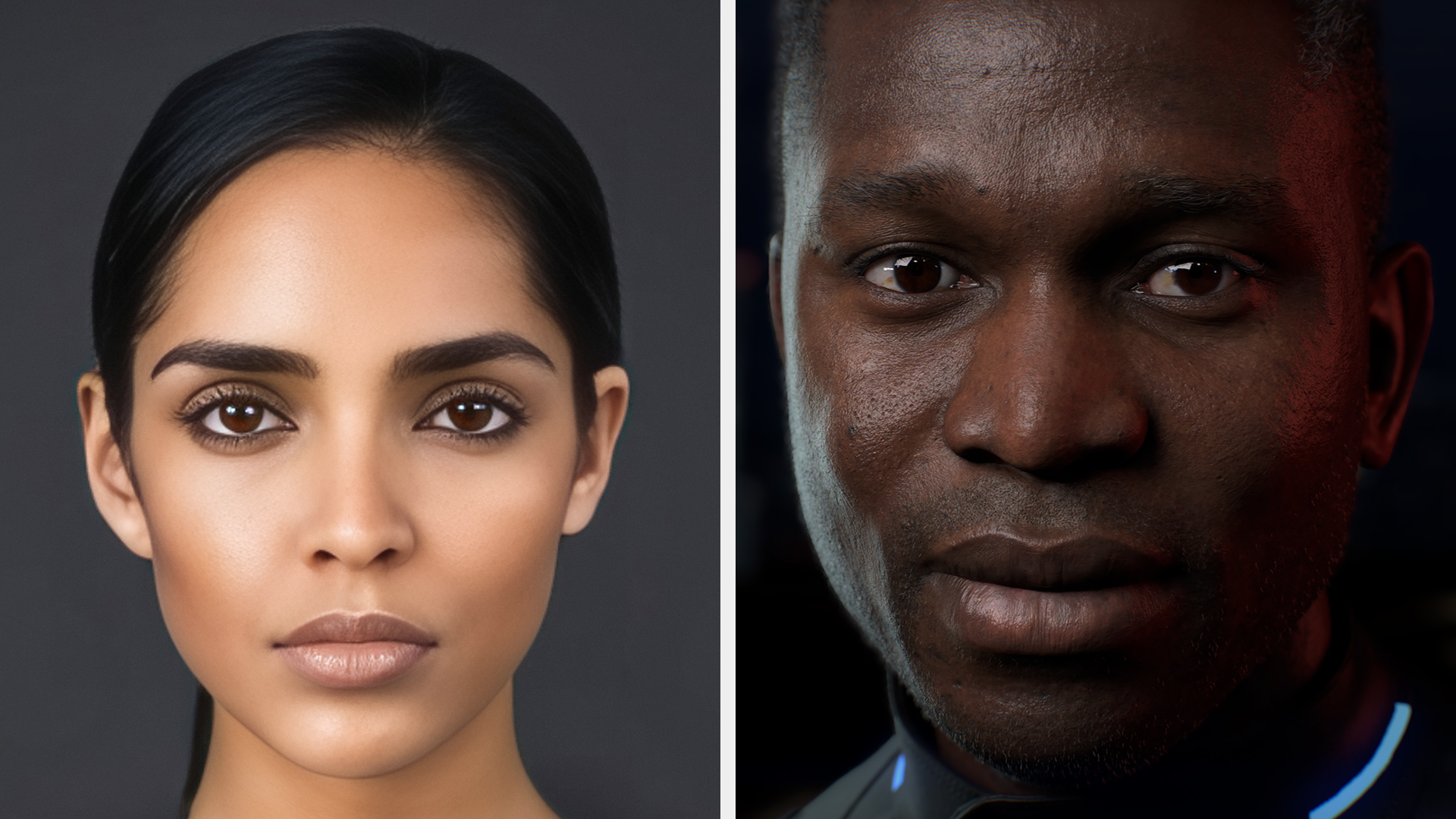
Digital avatars can give an AI agent a visual, voice-enabled interface, but the right choice depends on the interaction channel, desired realism, team skills, and rendering budget. Based on the source material, 2D avatars are suited to faster iteration and web or mobile embedding, while 3D avatars target more immersive, high-touch interactions. A project should validate the complete speech, retrieval, animation, rendering, and scaling path before selecting either approach.
What the digital avatar architecture supports
The described digital human AI blueprint connects a user to an AI agent using NVIDIA ACE technologies. Audio input is converted to text with Riva Parakeet NIM, then passed to a retrieval-augmented generation (RAG) workflow. The workflow uses NVIDIA NeMo Retriever embedding and reranking NIM microservices together with an LLM NIM to produce a response using relevant context from stored documents.
The response is converted back to speech through Riva TTS. Audio2Face-2D NIM or Audio2Face-3D NIM then animates the selected avatar. This architecture is intended to combine spoken interaction, knowledge-grounded responses, and an animated digital interface rather than treat the avatar as a standalone visual layer.
2D avatars for embedded conversational experiences
NVIDIA Audio2Face-2D is described as creating a 2D avatar from a portrait and voice input. The source positions this option for real-time output and cloud-native deployment, especially interactive web-embedded experiences. It can be relevant when an organization needs to place an AI agent within web or mobile customer journeys or deploy the same experience across multiple devices.
Compared with a 3D approach, 2D avatar development can be faster and require less technical investment. Teams can focus on portrait design, animation quality, speech interaction, and integration with the agent workflow instead of building detailed body animation and high-quality 3D rendering. That tradeoff may be appropriate where quick iteration, broad device reach, and a streamlined interface matter more than fully immersive presentation.
3D avatars for immersive interactions
3D avatars are intended for scenarios where presentation, realism, and a stronger sense of presence are important, such as physical retail settings, kiosks, or primarily one-to-one interactions. The source states that NVIDIA Audio2Face-3D and Animation NIM microservices generate blendshapes and subtle head and body animation for 3D characters.
The blueprint supports two 3D rendering options: NVIDIA Omniverse Renderer and Unreal Engine Renderer. This gives development teams a rendering choice, but it also makes project evaluation more demanding. A 3D implementation requires appropriate character assets, animation capability, rendering expertise, and performance testing at the intended output resolution.
How to evaluate the deployment path
- Define the interaction setting. Identify whether users will engage through a website, mobile journey, kiosk, or another one-to-one experience. This establishes whether a 2D or 3D interface is the better starting point.
- Test the end-to-end agent flow. Evaluate speech recognition, retrieval quality, LLM responses, text-to-speech output, avatar synchronization, interruption handling, and language requirements as one user journey.
- Measure the rendering footprint. For 3D avatars, assess the character asset quality, target resolution, selected renderer, and stream throughput. The source notes that these factors materially affect compute required per stream.
- Confirm the implementation scope. Review dated NVIDIA product documentation and the complete project BOM to confirm supported versions, deployment requirements, service interfaces, and licensing or commercial terms. These details are not established by the source record.
Limits and decision factors
Neither avatar type automatically improves response accuracy. Response quality depends on the underlying documents, RAG configuration, model behavior, speech processing, and testing against real user tasks. Multilingual interaction, intelligent interruption, and handoff behavior should also be validated for the languages and operating conditions required by the deployment.
The source identifies lower hardware requirements as a potential benefit for 2D deployments, but it does not provide quantitative hardware specifications, throughput figures, latency targets, or cost comparisons. Organizations should therefore use project tests rather than assume a specific capacity or user experience outcome.
FAQ
When should an organization choose a 2D digital avatar?
Choose 2D as the initial path when the AI agent will be embedded in web or mobile experiences, when rapid iteration is important, or when the team does not need immersive 3D presentation. Validate portrait quality, speech-to-animation synchronization, browser or device behavior, and concurrent-stream requirements in the target environment.
What should be verified before adopting a 3D avatar?
Verify the selected character assets, renderer choice between NVIDIA Omniverse Renderer and Unreal Engine Renderer, target resolution, stream throughput, and compute footprint. The team should also confirm it has the 3D, animation, and rendering skills needed to deliver and maintain the intended experience.
Conclusion
2D and 3D digital avatars provide different interface paths for voice-enabled AI agents. Use 2D for streamlined embedded interaction and faster iteration; consider 3D when immersive presentation justifies the additional asset, rendering, and scaling work. Confirm final technical and commercial suitability through official dated documentation, a complete BOM, and an end-to-end project evaluation.
After reviewing Choosing 2D or 3D Digital Avatars for AI Agent Interfaces, continue with buyer selection questions for related evaluation paths.

 WeChat
 Profile