
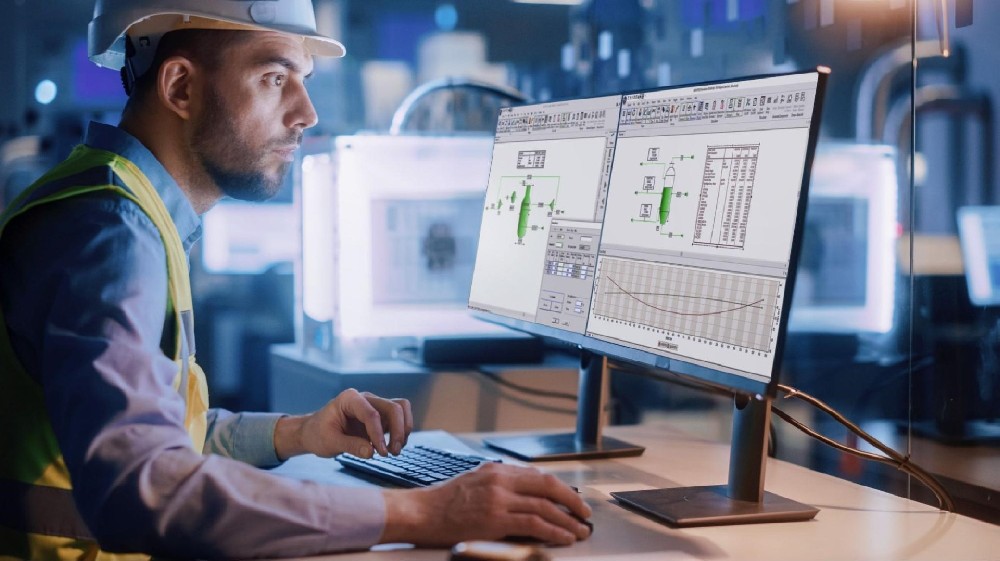
AVEVA Dynamic Simulation integrated with NVIDIA Raptor is presented as an approach for training deep reinforcement learning (DRL) agents against industrial process simulations before a control policy is considered for use in a plant control system. The source describes this combination as a way to address process disturbances that can be difficult for conventional control approaches to manage, particularly where operators would otherwise need to intervene manually to stabilize operations.
The industrial control problem
Traditional advanced process control and closed-loop real-time optimization can be effective when operating conditions are repeatable and relatively stable. Industrial facilities, however, also encounter transient events, including feed changes and unexpected disturbances. In these conditions, basic and advanced process controls may not maintain the required operating range, product quality, or equipment stability without operator action.
The source positions higher industrial autonomy as a potential means to support safer operations, more efficient equipment use, improved decision-making, centralized management of distributed assets, and more consistent process performance. These outcomes should be evaluated for each facility rather than assumed from a simulation or training result.
What the AVEVA and NVIDIA Raptor workflow supports
AVEVA Dynamic Simulation is described as a rigorous first-principles simulator for industrial processes. It can be used to build dynamic process models that provide the training environment for NVIDIA Raptor, a deep reinforcement learning engine.
In the stated workflow, the DRL agent sends actions to the AVEVA Dynamic Simulation model. The model returns a new state, and the agent receives a reward according to whether its action leads to a better or worse state. Across repeated action sequences, the agent learns a policy intended to maximize reward.
- AVEVA Dynamic Simulation provides the dynamic industrial-process model.
- NVIDIA Raptor supports large-scale reinforcement learning training with accelerated computing in on-premises or cloud environments.
- The resulting control policy can be evaluated before any consideration of deployment to a plant control system.
- The source also describes broader work involving industrial digital twins, unified operational centers, and accelerated-computing reference designs for AI workloads.
Suitable evaluation scenarios
This approach is most relevant where process behavior changes rapidly, where disturbances are costly to manage, or where repeated manual intervention is needed. The source uses a distillation example that separates heavier propane from lighter methane and ethane. When feed variation exceeds expectations, conventional control may struggle to keep levels and product quality within the appropriate range.
For this example, a Raptor DRL agent was trained with AVEVA Dynamic Simulation to control heat sent to the column, column-bottom level, and reflux-drum level. The source reports that the agent reduced distillation-system stabilization time by half while keeping temperature and product quality within the required range under large feed changes, compared with a traditional basic industrial controller. This is a source-specific example, not a universal performance commitment for other plants, models, controllers, or operating conditions.
How to assess a deployment path
- Define the operating problem. Identify the disturbance scenarios, controlled variables, safety constraints, quality targets, and operator intervention points that matter for the process.
- Build and review the simulation model. Confirm that the Dynamic Simulation model represents relevant process behavior and operating boundaries. Model fidelity is central to the credibility of training results.
- Train offline. Use simulated scenarios to train and test the DRL policy without training directly on the operating plant, as described in the source.
- Validate against plant requirements. Evaluate policy behavior across normal, transient, startup, shutdown, and abnormal conditions that are relevant to the project.
- Plan controlled integration. Before connecting a policy to a plant control system, verify integration architecture, safeguards, operating procedures, and acceptance criteria using complete project documentation and plant-specific testing.
The source states that AVEVA planned pilot, productization, and scaling activities, including potential no-code workflows in AVEVA Connect after successful customer pilots. It does not establish the commercial status, product availability, supported interfaces, deployment requirements, or outcomes of those future activities. These items require verification in dated official AVEVA and NVIDIA documentation and in the complete project scope.
FAQ
Can NVIDIA Raptor train a control agent without operating on the live plant?
According to the source, Raptor can use AVEVA Dynamic Simulation dynamic process models for offline training, testing, and validation. Whether a specific model is sufficiently representative for a particular plant must be established through project validation.
Does the distillation result guarantee a two-times faster stabilization result?
No. The reported reduction in stabilization time applies to the source's distillation example and its comparison with a traditional basic controller. Actual results depend on process design, model quality, disturbances, control constraints, reward design, and the validation method.
Conclusion
AVEVA Dynamic Simulation with NVIDIA Raptor provides a simulation-led path for evaluating DRL-based industrial control policies. Its practical value depends on a credible process model, clearly defined safety and operating limits, offline validation, and plant-specific testing before any operational deployment decision.
After reviewing AVEVA Dynamic Simulation with NVIDIA Raptor for Industrial Control, continue with NVIDIA products and networking solutions for related evaluation paths.

 WeChat
 Profile