
Business Goals
ITZKXY enterprise networking and AI infrastructure support
Explore an NVIDIA SuperNIC-based AI network approach using RoCE, GPUDirect RDMA, adaptive routing, telemetry-driven congestion control, DOCA programmability, and inline encryption.
View SolutionTesting and compatibility validation

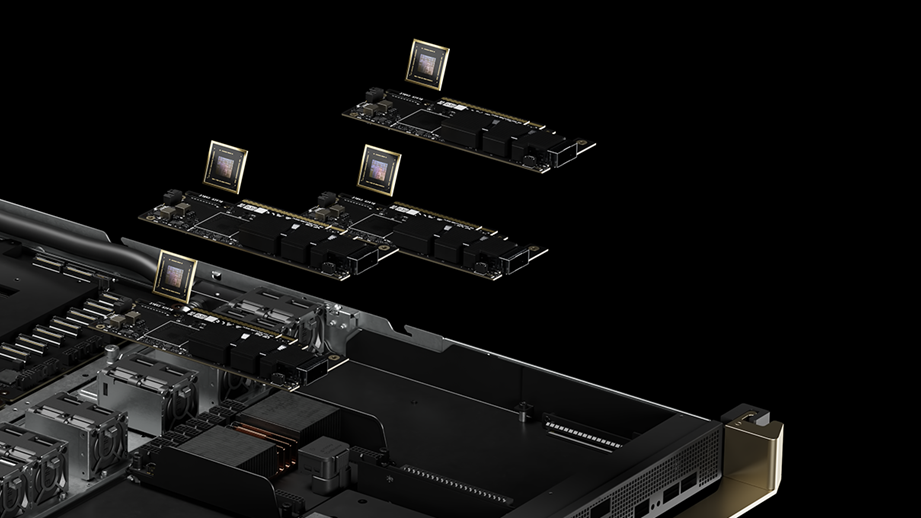
NVIDIA SuperNIC can support a network design for distributed AI workloads where GPU-to-GPU data movement, congestion response, and data-in-transit protection are central constraints. The source describes SuperNICs as key components in NVIDIA Spectrum-X Ethernet and Quantum-X800 InfiniBand platforms. For large training environments, the practical objective is to reduce CPU involvement in data movement while building a fabric that can handle sustained high-bandwidth flows and short synchronization bursts.
As AI training expands across many GPUs and nodes, the network carries large datasets, model-state exchanges, and collective communication traffic. These patterns can create persistent high-bandwidth “elephant flows” as well as short, sharp traffic peaks during synchronization. A conventional CPU-mediated transfer path can introduce overhead, while static multipath behavior may leave some paths congested even when capacity exists elsewhere.
The source positions NVIDIA SuperNICs for hyperscale AI workloads that need direct GPU communication, adaptive traffic handling, programmable I/O processing, and accelerated encryption. ConnectX-8 SuperNIC is described with total throughput up to 800 Gb/s; however, a project team should confirm the throughput, port configuration, host compatibility, software versions, and supported features for its exact SKU and complete bill of materials.
The proposed architecture combines NVIDIA SuperNICs at the server edge with NVIDIA switching in the network fabric. SuperNIC hardware acceleration for RoCE and GPUDirect RDMA is intended to enable direct data movement between GPUs while bypassing the CPU in the data path. This can reduce CPU overhead and support higher parallelism for workloads distributed across multiple nodes.
For Ethernet-based AI fabrics, the source describes Spectrum-X RoCE dynamic routing working with NVIDIA Spectrum-4 Ethernet switches. Rather than relying solely on equal-cost multipath routing, this approach dynamically distributes traffic across available paths. Spectrum-4 packet spraying can spread packets across paths to balance load, but packet spraying can create out-of-order delivery. The source states that SuperNICs address this by placing received packets into buffers in the correct order.
The source describes in-band, high-frequency telemetry used with Spectrum-4 switches to let SuperNICs adjust transmission rates according to network utilization, with microsecond-level response precision. This is intended to address congestion before it degrades throughput and latency. Actual behavior depends on the end-to-end configuration and should be verified in a project test.
For I/O-intensive processing, the source also describes a Data Path Accelerator (DPA) with 16 hyper-threaded cores and support for DOCA-based programming. It identifies device emulation, congestion control, and traffic management as example low-code application areas. Teams should assess whether the operational value of custom DOCA development justifies the engineering, testing, lifecycle-management, and observability requirements.
Security is a separate architecture decision, not an automatic outcome of installing a network adapter. The source states that SuperNICs support hardware acceleration for IPsec, TLS, and scalable PSP encryption operations at speeds up to 800 Gb/s. Confirm the required encryption mode, key management, interoperability, policy controls, and measured performance for the intended deployment.
It is most relevant when distributed AI workloads require frequent, high-volume GPU communication across multiple servers and when congestion, CPU overhead, and data-in-transit protection are material design concerns. The source specifically frames SuperNICs for large-scale AI compute fabrics, AI factories, and cloud data centers.
No. The source describes up to 800 Gb/s throughput for ConnectX-8 SuperNIC and accelerated network functions, but training outcomes also depend on GPU and host configuration, topology, application communication behavior, switch configuration, software, and congestion conditions. Validate results using the target workload and production-like scale.
NVIDIA SuperNIC provides a potential architecture path for AI fabrics that need accelerated RoCE, GPUDirect RDMA, adaptive routing coordination, telemetry-informed congestion control, programmable I/O, and encryption acceleration. A defensible deployment requires confirmation against dated official documentation, the complete platform BOM, and workload-specific testing rather than relying on feature descriptions alone.
After reviewing NVIDIA SuperNIC Architecture for Scalable AI Networks, continue with NVIDIA products and networking solutions for related evaluation paths.
Testing and compatibility validation
ITZKXY enterprise networking and AI infrastructure support
Technical service and delivery support
Testing and compatibility validation
Project delivery and optimization support
Testing and compatibility validation
Solution planning and implementation support
Compatibility validation and project risk control
Testing and compatibility validation
Product selection and project support
ITZKXY enterprise networking and AI infrastructure support
Compatibility validation and project risk control
Product selection and project support
Product selection and project support
Testing and compatibility validation

 WeChat
 Inquiry
WeChat
WeChat Inquiry
 Profile
Company Profile
Profile
Company Profile