
Business Goals
ITZKXY enterprise networking and AI infrastructure support
A smart campus network solution framework for traffic visibility, anomaly analysis, operational dashboards, and evaluating backbone LAN and internet access requirements.

View SolutionTesting and compatibility validation
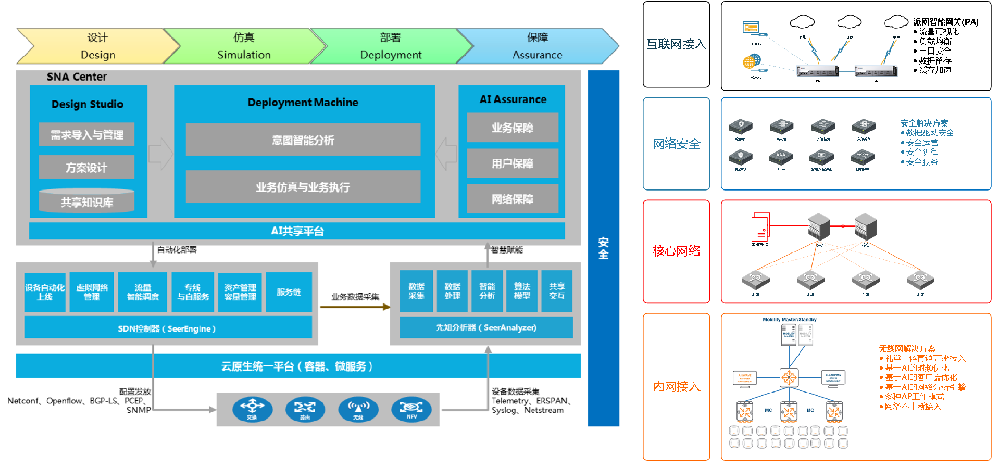
A smart campus network solution can help organizations evaluate and operate wired, wireless, and internet-access environments as infrastructure demand grows. Based on the supplied solution record, the focus is on visibility into bandwidth consumption, abnormal traffic analysis, operational dashboards, and diagnostics for complex user-experience issues. The record does not define a complete hardware or software bill of materials, so the final architecture must be confirmed against dated vendor documentation and project requirements.
The solution is suited to campus environments where existing IT infrastructure may no longer meet employee and user demand, where a growing organization expects higher data and information-service usage over the next three to five years, or where a new project requires an IT infrastructure foundation. It addresses two connected areas: intelligent internet access and a campus backbone LAN.
For network teams, the practical problem is not only capacity. A network may appear healthy for downloads and web browsing while a specific application experience, such as slow image loading in WeChat, remains poor. Identifying the affected traffic, its destination, source, and behavior is an important first step before changing bandwidth, routing, security policy, or access design.
The source describes an internet intelligent-access approach and a smart campus backbone LAN approach. Their common objective is to make network activity observable and easier to diagnose. Supported functions described in the source include traffic recognition, analysis of abnormal traffic, and operational monitoring views.
| Area | Capabilities described in the source | Operational purpose |
|---|---|---|
| Internet intelligent access | Efficient visual analysis of network bandwidth; identification and analysis of abnormal traffic | Investigate complex access and application-performance issues |
| Abnormal traffic investigation | Trend presentation, packet analysis, destination IP analysis, destination domain analysis, and source IP information analysis | Reconstruct network conditions during an incident and support fault location |
| Campus network operations | Dashboard views, alert statistics, wired and wireless resource statistics, endpoint usage, and access-method statistics | Provide a consolidated view of network and user-access activity |
| Traffic analysis | Traffic, application, and session-based charts; bandwidth baseline and trend views | Understand who used bandwidth, when, for how long, and where traffic originated and terminated |
Visibility can improve diagnosis, but it does not by itself establish the root cause or resolve a bandwidth bottleneck. An abnormal-traffic trend may indicate where to investigate, while packet, destination IP, domain, source IP, application, and session evidence help narrow the diagnosis. The source does not identify products, interface speeds, topology, capacity limits, security functions, licensing, integrations, deployment model, or service commitments. Buyers should verify these items in dated official product documentation, a complete SKU/BOM, and a proof-of-concept test.
The source states that the internet intelligent-access solution is intended to analyze complex cases such as fast downloads and smooth web browsing alongside slow WeChat image loading. A project test is still needed to verify whether the proposed deployment can collect the traffic, packet, domain, and endpoint evidence required for the specific application and network path.
Confirm the required dashboard metrics, traffic collection locations, wired and wireless coverage, internet-access design, alerting needs, data retention, and investigation workflow. Request a complete SKU/BOM and dated official documentation to verify exact functions, scale, interfaces, dependencies, and licensing.
This solution framework centers on campus network observability: bandwidth analysis, abnormal-traffic investigation, operational dashboards, and traffic baselines. It can provide a structured path for diagnosing access and performance issues, provided the final design is validated against the actual topology, data-collection requirements, and documented component capabilities.
After reviewing Smart Campus Network Solution for Visibility and Operations, continue with related solutions for related evaluation paths.
Testing and compatibility validation
ITZKXY enterprise networking and AI infrastructure support
Technical service and delivery support
Testing and compatibility validation
Project delivery and optimization support
Testing and compatibility validation
Solution planning and implementation support
Compatibility validation and project risk control
Testing and compatibility validation
Product selection and project support
ITZKXY enterprise networking and AI infrastructure support
Compatibility validation and project risk control
Product selection and project support
Product selection and project support
Testing and compatibility validation

 WeChat
 Inquiry
WeChat
WeChat Inquiry
 Profile
Company Profile
Profile
Company Profile