
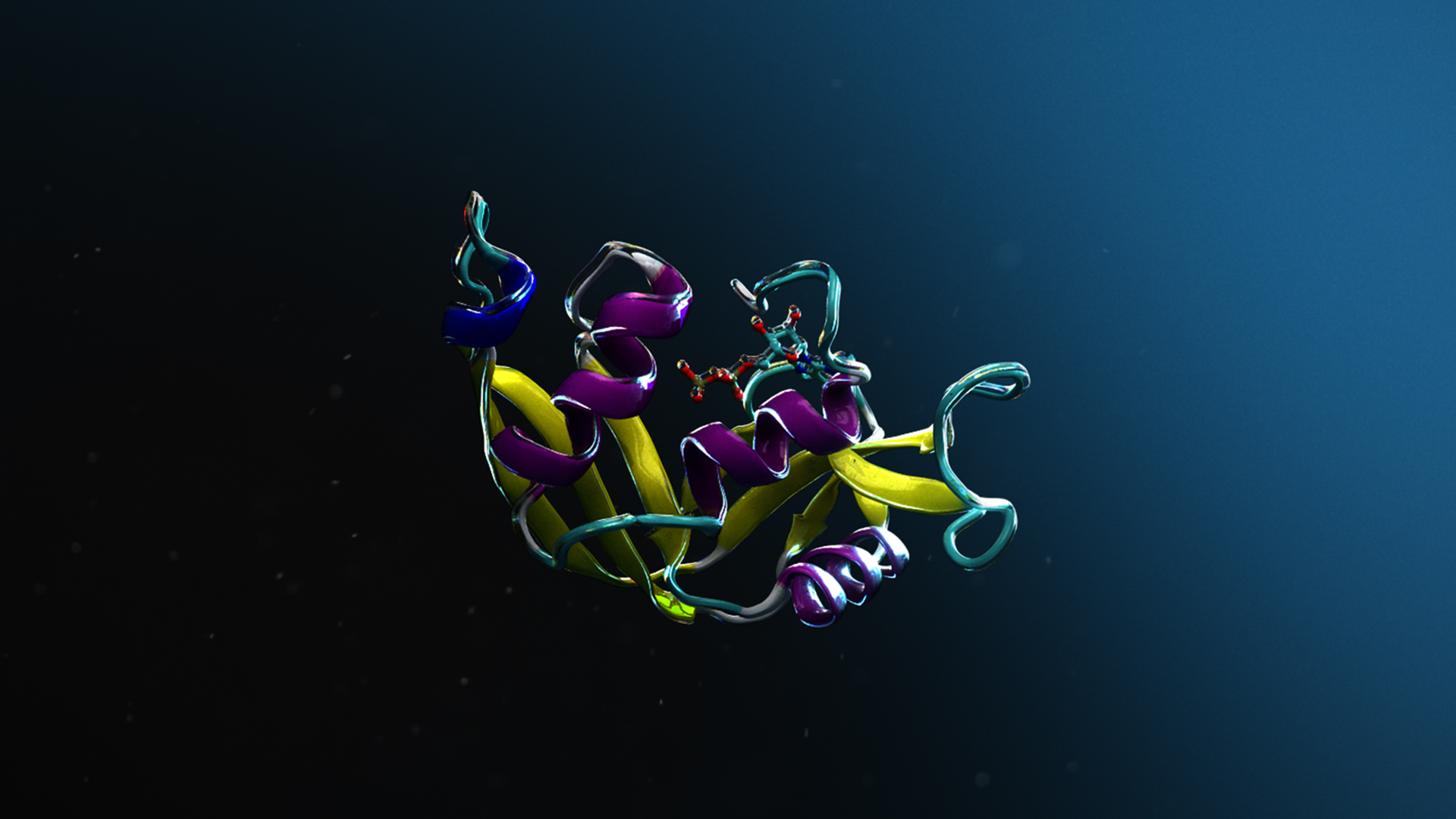
NVIDIA cuEquivariance is a CUDA-accelerated mathematical library designed to support equivariant neural networks (ENNs) used in scientific AI. It addresses a practical challenge in molecular and materials modeling: scientific datasets can be limited, while models must represent physical relationships accurately. The source describes cuEquivariance as a public beta available through GitHub and PyPI at the time of publication. Teams should confirm supported releases, dependencies, APIs, and hardware requirements in dated official documentation before adopting it in a research or production workflow.
Why equivariance matters for scientific models
Scientific AI models may predict molecular structures, protein-ligand binding poses, atomic interactions, or material properties. In these settings, a model often needs to account for symmetries such as three-dimensional rotations. An equivariant neural network is designed so that a transformation of the input produces a corresponding, predictable transformation of the output.
For example, when a model processes a 3D molecular representation, rotating the molecule should not require separate training examples merely to preserve a property that does not change with orientation. According to the source, embedding these symmetries into the network can improve robustness, data efficiency, and generalization to unseen data. These are architectural benefits rather than guaranteed project outcomes; model accuracy still depends on data quality, task definition, training design, and validation.
The computational challenge behind ENNs
Many ENN approaches use irreducible representations, commonly called irreps, to process symmetry-related transformations. Models cited in the source include Tensor Field Networks, LieConv, Cormorant, SE(3)-Transformer, NequIP, DiffDock, and Equiformer. Their mathematical operations can involve tensor algebra and tensor products governed by group-theory rules.
This creates two implementation constraints. First, constructing and processing irrep-based operations is theoretically complex, especially where reusable primitives and scalable APIs are limited. Second, common matrix sizes for 3D rotational operations may not map directly to conventional hardware optimizations. Tensor-product operations also follow sparse Clebsch-Gordan coefficient patterns. Treating those patterns as dense calculations can waste memory and reduce computational efficiency.
How cuEquivariance approaches acceleration
The cuEquivariance Python frontend introduces Segmented Tensor Product (STP), a framework for organizing algebraic operations involving irreps while accounting for sparse mixing-coefficient patterns. The source states that STP generalizes equivariant multilinear products and can represent a range of operations between irreps. It can also define operations that are not necessarily equivariant, which may be relevant to experimental research work.
Its CUDA backend provides specialized kernels for commonly used STP instances. The approach described in the source combines operations that would otherwise run separately, reducing intermediate loading, storage, and kernel-launch overhead. It also reorganizes feature memory layouts to better fit NVIDIA GPU single-instruction, multiple-thread execution. The intended result is faster mathematical processing for ENN workloads on NVIDIA GPUs.
Where to evaluate it first
The source discusses DiffDock, a diffusion model for predicting protein-ligand binding poses, and MACE, a machine-learned interatomic potential used in materials science and biology for molecular-dynamics simulations. These are relevant evaluation contexts because both include multiple irrep-based tensor operations. However, the source’s figures describe selected operations and benchmark configurations; they do not establish a universal performance result for every model, GPU, dataset, precision setting, or deployment environment.
- Identify whether the target model uses irrep-based tensor products, symmetric contractions, or comparable equivariant operations.
- Confirm compatibility with the required model implementation, Python environment, CUDA stack, and NVIDIA GPU architecture using dated official documentation.
- Benchmark end-to-end training or inference on representative workloads, rather than relying only on isolated operator measurements.
- Validate scientific outputs against the existing baseline, including rotational behavior, numerical stability, accuracy, and reproducibility at the intended precision.
FAQ
Does cuEquivariance guarantee more accurate drug-discovery or materials models?
No. The source explains that equivariant architectures can improve data efficiency, robustness, and generalization by encoding symmetry, while cuEquivariance targets the computational cost of their operations. It does not provide a guarantee of accuracy for a specific drug-discovery or materials-science project. Teams should test relevant datasets, model configurations, and scientific validation criteria.
Can cuEquivariance be evaluated with any NVIDIA GPU workflow?
The source describes a backend optimized for NVIDIA GPUs, but it does not provide a complete compatibility matrix. Verify the supported GPU architectures, CUDA versions, framework integrations, package versions, and precision behavior in dated official product documentation before planning deployment.
Conclusion
cuEquivariance targets a key barrier to broader use of equivariant neural networks: efficient execution of irrep-based mathematical operations. For teams building scientific AI around molecular geometry or material structure, it is most useful to assess the library through a controlled end-to-end benchmark and scientific-output validation, with final compatibility and support decisions based on official documentation and the project’s complete software environment.
After reviewing NVIDIA cuEquivariance for Equivariant AI in Science, continue with NVIDIA products and networking solutions for related evaluation paths.

 WeChat
 Profile