
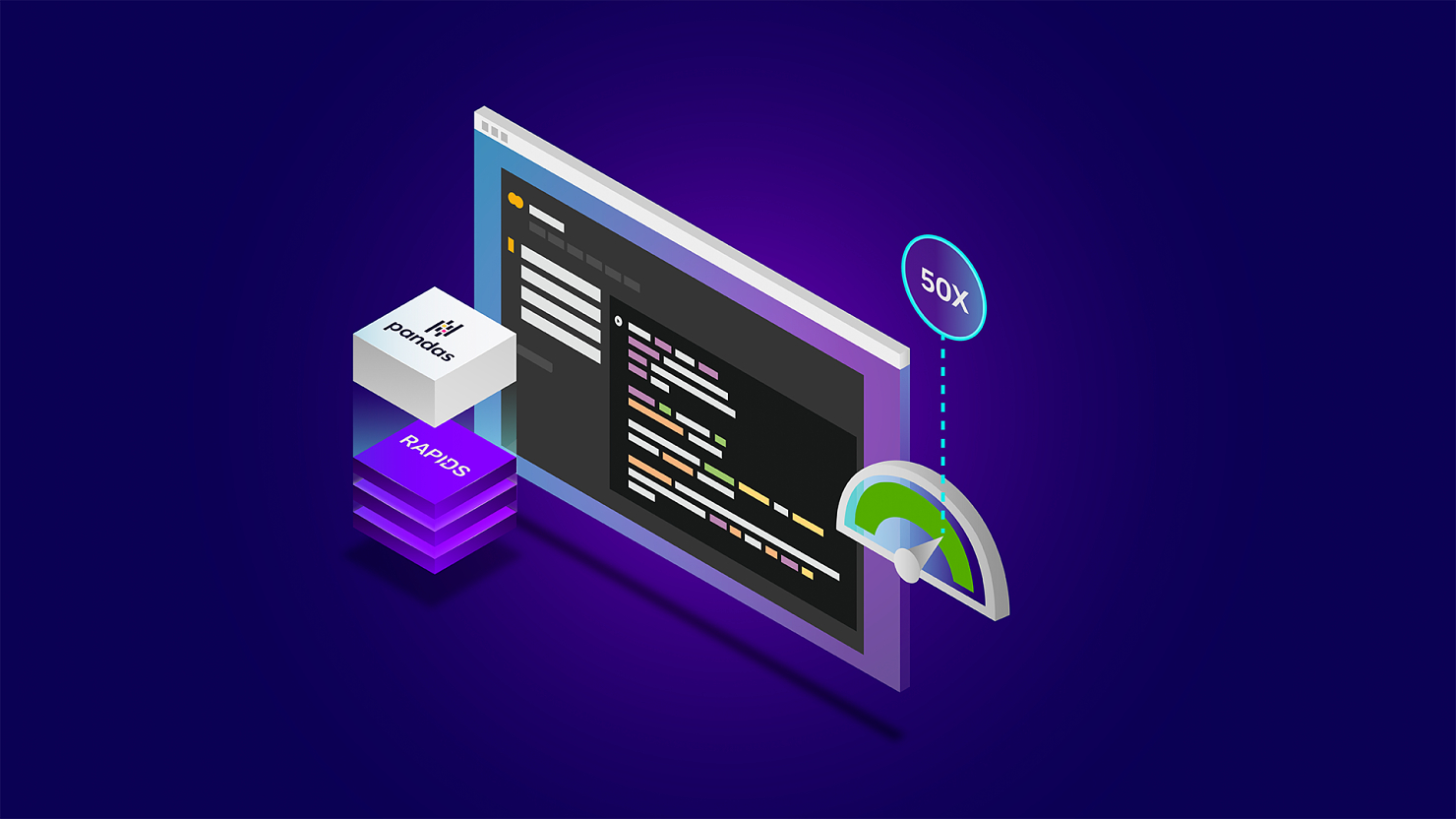
RAPIDS cuDF-pandas is designed to accelerate familiar pandas workflows by executing supported operations on a GPU while retaining a CPU fallback path when needed. Its use of CUDA Unified Virtual Memory (UVM) is intended to help workloads process datasets that exceed physical GPU memory, without requiring users to rewrite existing pandas code. Actual speed, compatibility, and memory behavior depend on the operations, data layout, hardware, software versions, and workload access patterns.
What cuDF-pandas supports
cuDF-pandas is a GPU-acceleration layer within the NVIDIA RAPIDS ecosystem. It acts as a proxy for pandas operations: where an operation can run through the GPU-accelerated path, cuDF-pandas attempts to execute it on the GPU; where that is not possible, it can fall back through pandas on the CPU. This model is intended to preserve the established pandas development experience while introducing CPU/GPU execution behind the same workflow.
The source describes a claimed performance improvement of up to 50 times for some pandas workloads without code changes. This figure should not be treated as a general result. Buyers and engineering teams should validate representative queries, joins, file operations, and end-to-end pipelines in their own environment before setting performance expectations.
Why Unified Virtual Memory matters
GPU memory capacity can constrain data-processing workloads, especially when datasets are larger than the GPU's physical memory. CUDA UVM provides a shared virtual address space across host CPU memory and GPU memory. This allows data to move between the host and device as it is accessed, rather than requiring every transfer to be managed explicitly by application code.
For cuDF-pandas, the source states that a UVM-backed managed memory pool is used by default. This approach can oversubscribe GPU memory by using system memory beyond the installed GPU memory capacity. When the GPU accesses data residing in host memory, a page fault can trigger migration to GPU memory. When GPU memory is full, less-used pages may move back to host memory.
This model can make larger workloads feasible, but it does not eliminate memory-management costs. Page faults and host-device migration can create latency and reduce throughput. The practical value of UVM therefore depends on whether its capacity and programming advantages outweigh migration overhead for a given workload.
Prefetching and data-processing behavior
The source identifies prefetching as an optimization used with UVM. APIs such as cudaMemPrefetchAsync can move required data toward GPU memory before a kernel executes, reducing runtime page-fault activity. In the described implementation, prefetching occurs at the libcudf layer for specific kernels, including hash joins.
This is particularly relevant for operations that require substantial data movement, such as large joins and I/O-related processing. In the source example, two large tables are merged in a Google Colab environment with limited GPU memory. Without UVM, the operation is described as failing because of insufficient device memory. With UVM enabled, the workload can use both host and device memory, while only needed portions are migrated to the GPU during execution.
Suitable scenarios and evaluation path
cuDF-pandas may be suitable for teams with existing pandas-based data workflows that want to assess GPU acceleration while minimizing application changes. It may also be relevant where data can exceed installed GPU memory but system memory is available to support managed-memory oversubscription.
- Identify pandas workloads that dominate runtime, such as merges, joins, concatenation, and Parquet writes.
- Run a baseline using the existing pandas workflow and record runtime, peak host memory, failure behavior, and output validation results.
- Test the same workflow with cuDF-pandas on the intended GPU and CPU configuration.
- Measure both individual operations and end-to-end execution, including data transfer, fallback behavior, and memory pressure.
- Verify the supported pandas API surface and all third-party library dependencies in dated official RAPIDS, cuDF-pandas, CUDA, and pandas documentation.
The source references tests on an NVIDIA T4 and an Intel Xeon Gold 6130 CPU, but those results should not be extrapolated to other platforms. A complete software stack, GPU model, GPU memory capacity, host-memory configuration, dataset characteristics, and concurrency profile should be included in a project test plan.
FAQ
Does UVM mean a workload larger than GPU memory will always run successfully?
No. UVM can use host memory to extend beyond physical GPU memory, but success and performance still depend on available system memory, access patterns, operation requirements, and migration overhead. Validate target workloads under realistic memory pressure.
Does cuDF-pandas guarantee that every pandas operation runs on the GPU?
No. The source describes GPU execution where possible and fallback through pandas where necessary. Teams should verify the exact operations, pandas API behavior, and third-party integrations required by their workflow in official version-specific documentation and testing.
Conclusion
cuDF-pandas combines GPU-oriented execution, pandas fallback, and CUDA UVM to address performance and memory-capacity challenges in pandas workflows. Its strongest fit is a measured evaluation of existing data pipelines, especially large joins and file-processing tasks. The expected benefit must be established through project-specific compatibility, memory, and end-to-end performance testing.
After reviewing RAPIDS cuDF-pandas: GPU Acceleration with Unified Virtual Memory, continue with NVIDIA products and networking solutions for related evaluation paths.

 WeChat
 Profile