
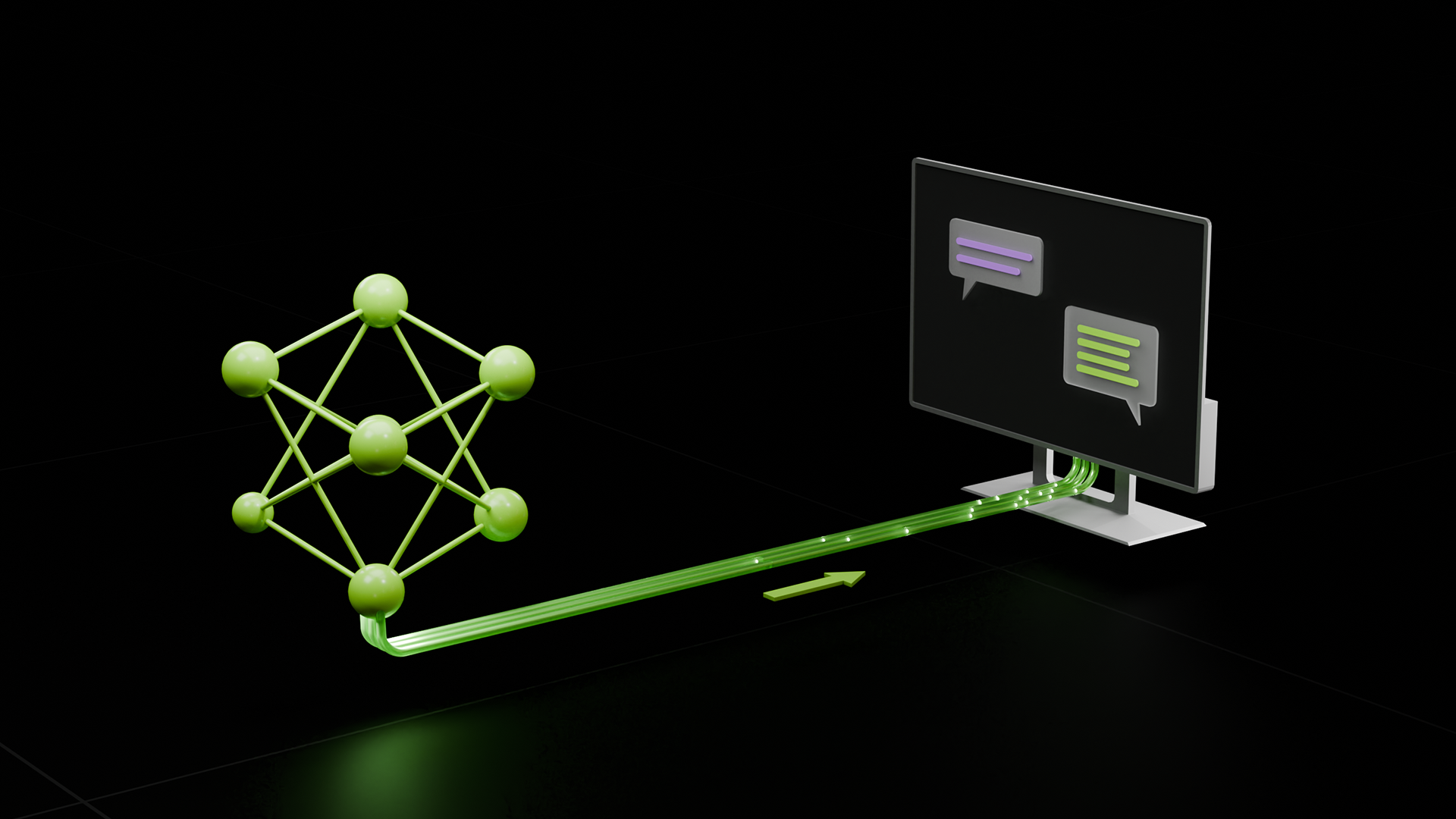
TensorRT-LLM support for Recurrent Drafting (ReDrafter) provides an engine-level speculative decoding approach for NVIDIA GPU-based LLM inference. The source describes ReDrafter as an open-source technique developed by Apple that uses RNN-based drafting and tree attention to predict candidate tokens, which the primary model then verifies. It is intended to improve inference efficiency when candidate tokens are accepted at a sufficiently high rate, particularly in lower-traffic conditions where GPU utilization may be limited.
The inference problem ReDrafter addresses
Autoregressive LLM generation normally produces tokens sequentially. Speculative decoding changes that workflow by using a smaller drafting component to propose multiple future tokens in parallel, followed by verification by the main model. When valid draft tokens can be accepted, the decoder can advance by more than one token in an iteration while preserving the main model's output verification process.
The source notes that speculative decoding is not automatically beneficial in every deployment. It adds drafting and verification work, and some candidate paths may be discarded. Its value therefore depends on whether accepted candidates offset the extra computation and latency introduced by the technique.
What TensorRT-LLM integration adds
TensorRT-LLM is described in the source as an LLM inference optimization library with a Python API for defining models and building NVIDIA TensorRT engines. Its cited optimization capabilities include custom Attention Kernel support, Inflight Batching, Paged KV Caching, and FP8, INT4 AWQ, and INT8 SmoothQuant quantization techniques.
For ReDrafter, the reported implementation moves drafting and verification into a single TensorRT-LLM engine rather than relying on runtime handling or separate engines. The stated purpose is to reduce overhead and give TensorRT-LLM more freedom in kernel selection and scheduling. This differs from the source's description of earlier Medusa handling, where runtime processing had to account for possible future paths before the accepted path was known.
Inflight Batching and engine behavior
The integration is designed to work with Inflight Batching (IFB), which processes context-phase and generation-phase requests in batches to improve throughput. ReDrafter makes this workflow more complex because generation requests require draft-token verification, whereas context requests are processed differently.
According to the source, the ReDrafter-compatible engine splits a batch into context and generation sub-batches, processes them through the compute workflow, combines them, and then continues to drafting. Operators on each path must support empty tensors, since a batch may contain only context requests or only generation requests. Teams evaluating this design should confirm that their model definition, plugins, and serving path handle those conditions correctly.
Where evaluation is most appropriate
- Low-traffic or small-batch inference: The source identifies lower GPU utilization as a condition where speculative decoding can be useful.
- Tasks with predictable continuation: Code completion is given as an example where future-token prediction may be easier and acceptance rates may be higher.
- Deployments that can test acceptance behavior: Beam count, beam length, beam-search quality, and training data can affect the average acceptance rate and resulting performance.
Apple benchmark results cited in the source report up to 2.7x throughput versus a base LLM when ReDrafter was used with TensorRT-LLM on a TP8 NVIDIA GPU configuration. This is not a general performance commitment. It must not be extrapolated to another model, prompt mix, GPU topology, traffic level, quantization setting, or serving configuration without project-specific measurement.
Evaluation path and evidence limits
- Identify representative models, request lengths, concurrency levels, and task types for the intended service.
- Measure baseline latency, throughput, GPU utilization, and output behavior before enabling speculative decoding.
- Measure draft-token acceptance rate alongside end-to-end latency and throughput after integration.
- Test context-only, generation-only, and mixed IFB batches to validate empty-tensor handling and scheduling behavior.
- Verify supported APIs, model requirements, software versions, and deployment instructions in dated official TensorRT-LLM documentation and the complete project BOM.
FAQ
Does ReDrafter guarantee faster LLM inference?
No. The source explicitly states that results depend on GPU utilization, average acceptance rate, beam configuration, beam-search quality, and task characteristics. A project benchmark is required to establish whether the added drafting work produces a net benefit.
Is the cited 2.7x throughput figure applicable to every NVIDIA GPU deployment?
No. The figure is attributed to Apple benchmarking with TensorRT-LLM on a TP8 configuration using eight GPUs. Confirm comparable results only through testing with the target hardware, model, workload, and serving stack.
Conclusion
ReDrafter support extends TensorRT-LLM with an engine-integrated speculative decoding design that combines RNN-based drafting, tree attention, and main-model verification. It is most relevant where acceptance rates and GPU utilization make speculative decoding worthwhile. Deployment decisions should be based on dated official documentation and measurements from the intended production workload.
After reviewing TensorRT-LLM Support for Recurrent Drafting Explained, continue with buyer selection questions for related evaluation paths.

 WeChat
 Profile