
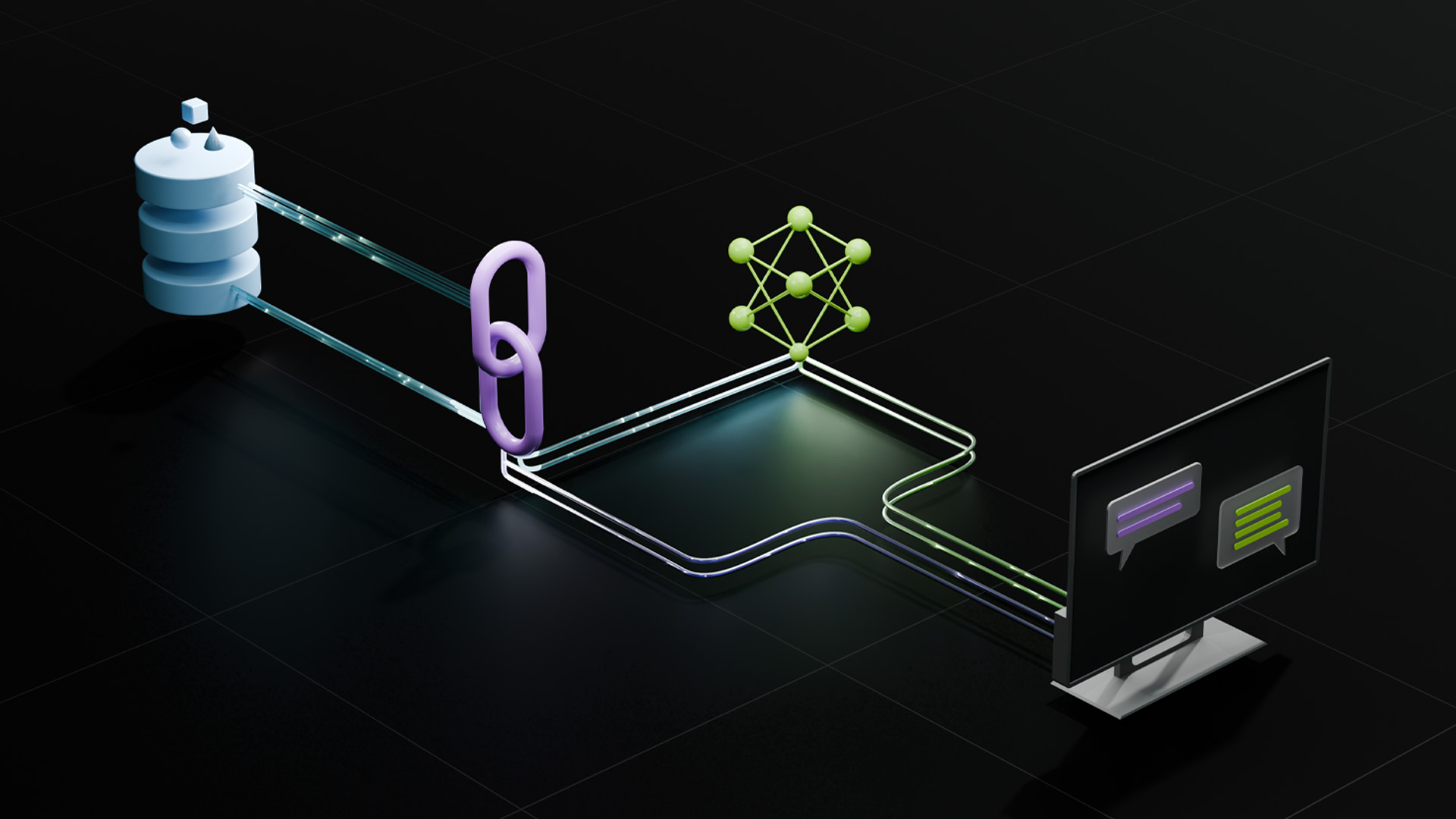
Retrieval-augmented generation (RAG) can help AEC teams use language models with selected organizational knowledge instead of relying only on a model’s general training data. For architecture, engineering, and construction work, this approach is relevant when answers must reflect project documents, design specifications, building codes, historical proposals, or other controlled sources. It does not make an AI response automatically correct: teams still need to validate source quality, permissions, retrieval results, and final decisions.
Why generic LLM answers can be insufficient for AEC work
Large language models can support natural-language search, content drafting, and analysis, but their training data has a cutoff date and may not include proprietary, project-specific, or rapidly changing information. They can also misunderstand context or generate plausible but unsupported content. In AEC, those limitations matter when a question concerns local requirements, site conditions, design constraints, or current project status.
For example, a general model may suggest broad sustainability measures for a mountain building without addressing altitude, temperature variation, or snow load. A reliable workflow must therefore connect the model to the documents that govern the work and preserve a review process for professional judgment.
What a RAG workflow adds
RAG combines a language model with retrieval from defined data sources. Before generating an answer, the system searches selected content for relevant context and supplies that context to the model. Depending on the implementation, the content may include internal knowledge systems, document stores, CRM or ERP data, project records, and approved external information.
This structure can support document retrieval, compliance-oriented checks, project knowledge access, cost-estimation research, and customer support. It can also improve traceability when the user can review the material used to support a response. Access control remains essential because the usefulness of internal data does not remove the need to restrict sensitive project information to authorized users.
Core components to evaluate
- Data extraction: Collect documents and data from approved sources, then determine ownership, currency, format quality, and access permissions. The source describes RAPIDS as a GPU-accelerated option for data preprocessing.
- Embedding generation: Convert document content into vector embeddings that represent semantic meaning. The source identifies NVIDIA NeMo Retriever as a set of retrieval microservices with embedding models for question answering and information retrieval.
- Vector storage and retrieval: Store embeddings in a vector database and retrieve relevant passages for each question. Retrieval quality depends on document preparation, chunking, metadata, and the query itself.
- Response generation: Provide retrieved context to an LLM to draft an answer. The source notes that NVIDIA GPUs can accelerate inference and that NVIDIA Triton Inference Server can manage model deployment and inference requests.
Suitable AEC scenarios and implementation path
A practical starting scenario is a controlled document collection, such as fire-safety references for high-rise projects. A user question can be embedded, matched against approved local codes, design guidance, and past project material, then answered with the retrieved context. The response should identify its supporting documents so an architect or engineer can examine them before acting.
Start with a limited use case and a bounded corpus rather than connecting every enterprise repository at once. Define which documents are authoritative, how often they are refreshed, which roles may access them, and what answer formats require citations or human approval. Test representative questions, including ambiguous requests and questions with no supporting evidence. Measure whether the system retrieves the right material before judging the quality of generated prose.
The source presents NVIDIA ChatRTX as an experimental way for an individual to use documents, notes, and images with a locally run chatbot on an RTX PC or workstation. It also describes NVIDIA AI Workbench for collaborative development across local, server, and cloud environments; NVIDIA NIM for containerized model deployment with industry-standard APIs; and an NVIDIA AI Blueprint for multimodal PDF data extraction. Confirm product versions, hardware requirements, supported models, licensing, security controls, and deployment suitability in dated official documentation before selecting any component.
FAQ
Does RAG replace AEC professional review?
No. RAG can retrieve selected information and generate a context-aware draft, but it does not establish that a design, interpretation, or compliance conclusion is correct. Qualified professionals must verify applicable local codes, project facts, calculations, and source documents.
Should an organization fine-tune a model instead of using RAG?
The source describes full retraining and fine-tuning as more resource-intensive approaches that can require specialized data, computing capacity, time, and expertise. RAG is positioned as a flexible option for connecting a model to selected and changing knowledge. The appropriate choice should be tested against the organization’s accuracy, update frequency, governance, and operating requirements.
Conclusion
RAG offers an architecture for grounding AEC AI assistance in defined organizational and project knowledge. Its value depends on trustworthy source material, effective retrieval, controlled access, visible evidence, and disciplined human review. Validate the complete workflow with real project questions before using outputs in design, compliance, or commercial decisions.
After reviewing RAG for AEC: A Practical Guide to Grounded AI Workflows, continue with buyer selection questions for related evaluation paths.

 WeChat
 Profile