
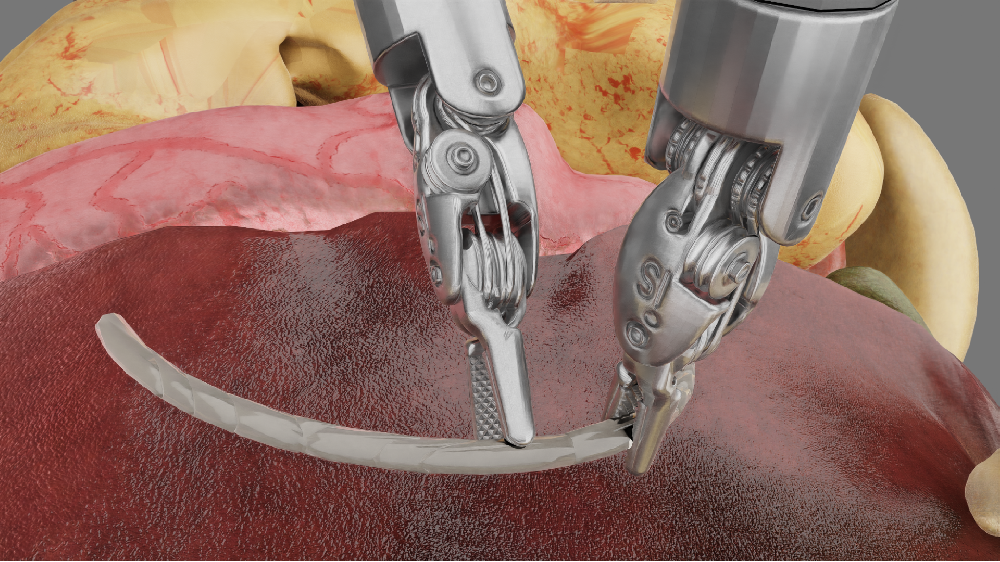
SuFIA and SuFIA-BC are research frameworks for developing and evaluating robot-assisted surgical capabilities in simulated and physical environments. The source describes SuFIA as using natural-language guidance and large language models (LLMs) for high-level surgical robot planning and control. SuFIA-BC extends this direction with behavior cloning (BC), using expert demonstrations to train visual-motor policies for surgical subtasks. These frameworks are relevant to research teams investigating how simulation, synthetic data, teleoperation, and perception models can support surgical robotics development.
The development problem addressed
Robot surgical assistants are operated by trained surgeons through a console, with the aim of improving dexterity, streamlining workflows, and reducing surgeon workload. Moving beyond remote operation toward more capable assistants requires training and evaluating policies for highly constrained, safety-sensitive tasks. The source identifies several practical barriers: limited access to surgical data, the cost of acquiring expert demonstrations, and the expense of required hardware.
The described approach uses a surgical digital twin to create a more accessible research environment. Rather than treating simulation as a substitute for clinical validation, it provides a setting for generating data, testing perception inputs, and comparing policy behavior before a system is considered for more demanding evaluation.
Framework capabilities described in the source
SuFIA applies natural-language guidance and LLMs to high-level planning and control for surgical robots. SuFIA-BC focuses on training behavior-cloning policies from demonstrations, with the stated objective of improving flexibility and precision in robot surgical assistance.
The source outlines a digital-twin workflow that begins with raw CT volume data and proceeds through organ segmentation, mesh conversion, mesh cleanup and refinement, realistic texturing, and assembly into a Unified Scene Description (OpenUSD) file in Omniverse. The resulting simulator is described as producing synthetic data for training and evaluating BC models on complex surgical tasks.
Visual observations considered in the research include RGB images from single-camera and multi-camera configurations, as well as point-cloud representations derived from single-camera depth data. This permits evaluation of perception choices against the requirements of a specific surgical subtask instead of assuming that one sensing approach is optimal for every task.
Suitable research and evaluation scenarios
The source describes five surgical subtasks used for evaluation: tissue retraction, needle pickup, needle handoff, suturing-pad threading, and bulk transfer. These provide a structured starting point for teams studying visual-motor learning, demonstration collection, and robustness in simulated surgical environments.
| Evaluation concern | Observation from the source | Decision implication |
|---|---|---|
| Spatially defined manipulation | Point-cloud-based models generally performed well on tasks such as needle pickup and handoff. | Assess depth-derived representations where spatial geometry is central to the task. |
| Semantic interpretation using color | RGB-based models performed better where color cues were needed for semantic understanding. | Retain RGB inputs when task success depends on visually distinguishing colored features. |
| Camera-view changes | Point-cloud models showed stronger robustness to viewpoint variation than RGB-based models in the reported evaluation. | Test camera-placement changes explicitly when considering deployment conditions. |
| Generalization across needle instances | Multi-camera RGB models showed better adaptability than point-cloud-based models in the reported comparison. | Evaluate generalization with representative instruments rather than relying on one training setup. |
The source also reports that model success varied with the number of expert demonstrations, especially when fewer demonstrations were used. For research programs with constrained data collection, sampling efficiency and failure analysis should therefore be part of model selection.
Evaluation path and evidence limits
- Define the intended subtask, instrument set, observation modes, and success criteria.
- Build or validate the digital-twin asset pipeline from CT data through OpenUSD assembly, including mesh and texture quality checks.
- Collect teleoperation demonstrations and document the number, task coverage, and operating conditions represented.
- Compare RGB, multi-camera RGB, and depth-derived point-cloud approaches against the same task protocol.
- Test sensitivity to camera viewpoints, demonstration volume, and different needle instances; record failure modes alongside success outcomes.
- Establish separate validation plans for any physical-environment or clinical use.
The source reports research findings but does not provide numerical performance results, hardware requirements, model versions, clinical outcomes, regulatory status, or deployment specifications. It also does not establish that these frameworks are suitable for autonomous clinical operation. Teams should verify implementation details in dated official project documentation, review the complete code and asset materials referenced by the source, and perform project-specific testing before drawing procurement, safety, or clinical conclusions.
FAQ
Is SuFIA-BC presented as a replacement for surgeon-operated robotic systems?
No. The source presents SuFIA-BC as a research framework for behavior cloning and evaluation of surgical robot-assistance subtasks. It does not establish replacement of surgeon control, autonomous clinical use, or clinical efficacy.
How should a team choose between RGB and point-cloud observations?
The choice should follow the task and test evidence. The reported study found relative strengths for point clouds in spatially defined tasks and viewpoint variation, while RGB approaches were stronger when color cues were important and multi-camera RGB adapted better across different needle instances. These observations should be reproduced under the team’s own data and operating conditions.
Conclusion
SuFIA and SuFIA-BC provide a research-oriented path that connects surgical digital twins, teleoperation demonstrations, LLM-guided planning, and behavior cloning. Their value lies in enabling controlled investigation of data, perception, and policy tradeoffs. Any move from simulation research to physical or clinical settings requires independent, documented validation beyond the evidence provided in the source.
After reviewing SuFIA and SuFIA-BC for Surgical Robot Simulation, continue with buyer selection questions for related evaluation paths.

 WeChat
 Profile