
Business Goals
ITZKXY enterprise networking and AI infrastructure support
Evaluate a dynamic resource allocation approach for AI training and inference appliances, including topology, memory, deployment checks, and evidence limits.

View SolutionTesting and compatibility validation
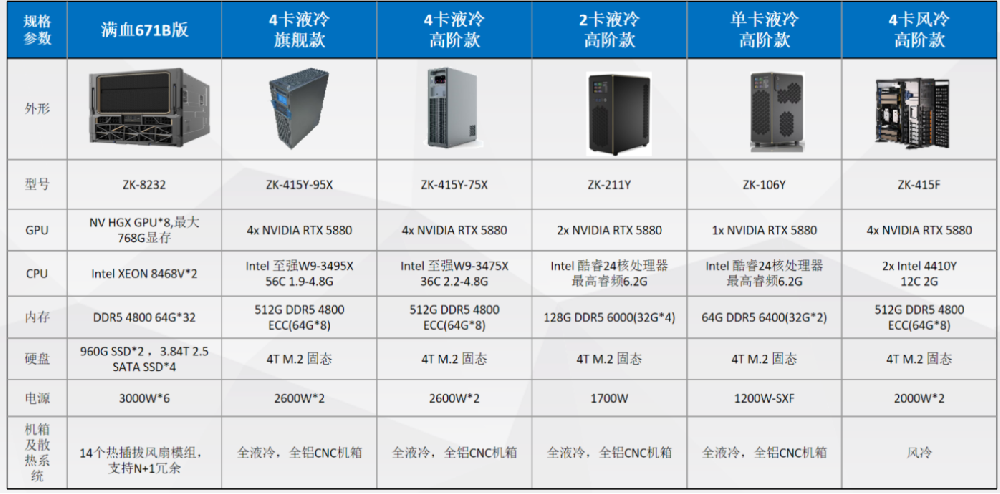
Organizations planning shared AI infrastructure can use a training-and-inference appliance to align GPU, system memory, storage, and scheduling capacity with changing workloads. The supplied source describes a dynamic resource allocation approach for local model inference, video analysis, training, and edge deployment. Its performance, stability, and power claims should be treated as vendor assertions until confirmed against dated product documentation, the complete SKU/BOM, and an environment-specific acceptance test.
Mixed AI estates often combine long-running training jobs, interactive inference, periodic batch processing, and real-time video workloads. Static allocation can leave GPU memory or host memory underused when one workload finishes while another waits for capacity. The source positions dynamic GPU-memory scheduling, adaptive memory-bandwidth control, and model sharding as mechanisms intended to make resource allocation more responsive to workload changes.
This approach may be relevant where a team needs to run several model sizes or workload classes on shared infrastructure, while retaining local deployment control. It is not enough, however, to select a system from model parameter count alone. Model architecture, quantization, context length, concurrency, batch size, framework version, storage throughput, networking, and availability requirements all affect the final design.
The source outlines a layered architecture built around multi-GPU compute, system memory, storage, and a virtualization or scheduling layer. It states that RTX 5880 Ada does not include NVLink, while claiming that an exclusive virtualization layer can provide transparent cross-node memory access. That behavior, its topology requirements, and its impact on application compatibility require validation; transparent access should not be assumed to provide the same behavior or performance characteristics as a hardware interconnect.
| Source-listed platform | Intended positioning in the source | Evaluation focus |
|---|---|---|
| ZK-8232 | Complex enterprise AI applications and large-scale clusters | Confirm the exact GPU model, memory capacity, interconnect design, power design, and software stack in the quoted BOM. |
| ZK-4 15 Y-95X / ZK-4 15 Y-75X | Four-GPU training and multimodal or digital-twin workloads | Measure distributed-training scaling, cooling requirements, recovery behavior, and sustained operation under the actual model and dataset. |
| ZK-2 11 Y / ZK-1 06 Y | Inference and lighter edge workloads | Test end-to-end latency, local environmental requirements, operational access, and model capacity at the required concurrency. |
| ZK-4 15 F | Private-cloud expansion and multiple smaller training tasks | Validate scheduler isolation, storage performance, rack power, and behavior when workloads contend for GPUs. |
The source reports utilization, power, bandwidth, latency, throughput, concurrency, fragmentation, stability, temperature, acoustic, and data-processing figures. It does not provide test methodology, baseline configuration, model precision, workload definitions, software versions, measurement periods, or independent results. These figures therefore cannot support a procurement commitment without verification.
Particular attention is needed for claims involving cross-card or cross-node memory behavior, large-model capacity, distributed training, thermal operation, and local deployment of models described as 670B or 671B parameters. Confirm licensing, model terms, supported APIs, security controls, networking requirements, and compatibility with the chosen framework through dated official documentation and project testing.
No. Parameter count is only one input. Precision, quantization, context window, KV-cache growth, concurrency, training versus inference, and the data path determine memory and compute demand. Test the intended model configuration on the exact quoted hardware.
No. The source makes several performance and efficiency claims, but it does not supply sufficient methodology to generalize them. A buyer should define measurable acceptance criteria and compare the proposed system with an agreed baseline in the target environment.
The source presents dynamic resource allocation as a path for shared AI training and inference infrastructure across enterprise, private-cloud, and edge scenarios. Treat the listed configurations as starting points for architecture discovery, then make the deployment decision from a dated BOM, documented software support, and workload-specific validation.
After reviewing Dynamic Resource Allocation for AI Training and Inference Appliances, continue with related solutions for related evaluation paths.
Testing and compatibility validation
ITZKXY enterprise networking and AI infrastructure support
Technical service and delivery support
Testing and compatibility validation
Project delivery and optimization support
Testing and compatibility validation
Solution planning and implementation support
Compatibility validation and project risk control
Testing and compatibility validation
Product selection and project support
ITZKXY enterprise networking and AI infrastructure support
Compatibility validation and project risk control
Product selection and project support
Product selection and project support
Testing and compatibility validation

 WeChat
 Inquiry
WeChat
WeChat Inquiry
 Profile
Company Profile
Profile
Company Profile