
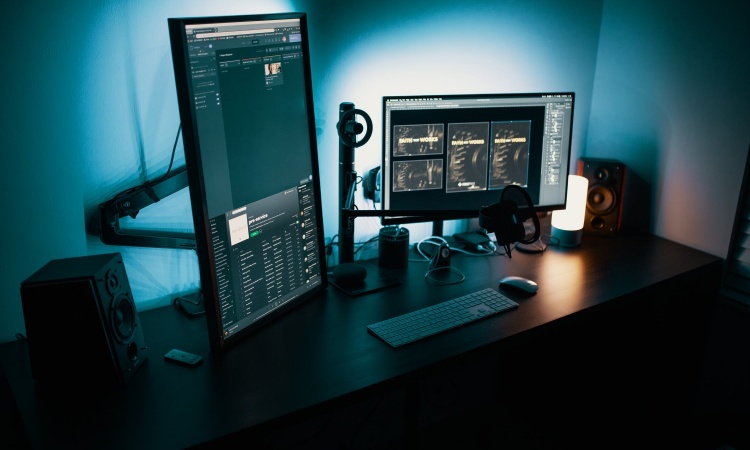
A DeepSeek training and inference appliance is presented as an integrated computing concept for organizations that want to support AI model development and inference within one coordinated hardware and software environment. The supplied source describes a design that brings compute, storage, and networking together to reduce friction between training and deployment. It does not provide a model number, complete configuration, measured performance data, or official compatibility documentation, so buyers should treat the claims as an evaluation direction rather than a confirmed product specification.
The problem an integrated appliance is intended to address: DeepSeek Training and Inference Appliance: Evaluation Guide
AI projects often move through separate environments for data preparation, model training, testing, and inference. Differences in configuration, software dependencies, resource allocation, or data movement between these stages can add operational work and complicate deployment. The source positions a training-and-inference appliance as a way to coordinate these stages through a unified design.
According to the source, the proposed architecture integrates key compute, storage, and network components so they can operate in a more coordinated manner. The intended outcome is faster data transfer between modules, lower data-transfer latency, and more efficient use of resources for deep-learning workloads. These are architectural goals described in the source; their results depend on the actual system design, workload, dataset, software stack, and operating configuration.
Capabilities described in the source
The source attributes the appliance concept to three broad capabilities:
- Integrated infrastructure: Compute, storage, and networking are described as being designed together for AI workloads rather than treated as entirely separate operating domains.
- Support for training and inference: The platform is described as supporting large-scale matrix operations used in deep-learning training and inference.
- A unified workflow: After a model is trained, the intended workflow is to move into inference without a complex migration or complete reconfiguration of the environment.
The source also states that a unified software framework and optimization methods may allocate resources according to task requirements. However, it does not identify the framework, supported operating systems, orchestration tools, APIs, GPU models, interconnects, storage architecture, or model versions. Those details must be confirmed in dated official product documentation and a complete SKU or bill of materials.
Scenarios that may fit the concept
The cited application areas include medical diagnostic assistance, intelligent transportation, and industrial manufacturing. In these contexts, the source associates the appliance with training models and running real-time or near-real-time inference workloads, such as diagnostic support, traffic analysis, defect detection, and production-line quality inspection.
Suitability depends on more than compute capability. A medical workflow may require validation of data governance, model behavior, integration, and applicable regulatory obligations. Transportation and manufacturing deployments need to assess input latency, camera or sensor pipelines, uptime requirements, and how inference results connect to operational systems. The source identifies possible domains but does not establish deployment results, accuracy, latency, compliance status, or customer outcomes for any of them.
How to evaluate a proposed configuration: DeepSeek Training and Inference Appliance: Evaluation Guide
- Define the workload: Document the models, parameter sizes, precision modes, training dataset size, expected inference concurrency, input formats, and response-time targets.
- Request the complete configuration: Obtain the processor, accelerator, memory, storage, network, power, software, and support components for the exact SKU. Do not infer these details from the appliance name.
- Validate software compatibility: Confirm supported DeepSeek models, model-serving tools, training frameworks, drivers, containers, APIs, and update procedures using dated vendor documentation.
- Run a representative test: Test with the target model, prompts or inputs, data pipeline, concurrency level, and security controls. Record training throughput, inference latency, throughput, stability, and operational effort under the intended conditions.
- Plan the operating model: Establish monitoring, capacity management, backup and recovery, access control, model versioning, and incident-handling responsibilities before production use.
Evidence limits and procurement considerations: DeepSeek Training and Inference Appliance: Evaluation Guide
The supplied source makes general statements about optimized architecture, powerful processors and graphics hardware, efficient resource use, and reduced training time. It does not substantiate those statements with benchmark methodology, hardware specifications, comparative testing, pricing, availability, power consumption, memory capacity, network bandwidth, service terms, or warranty information. It also does not confirm a specific relationship between DeepSeek and any hardware vendor.
Procurement teams should therefore compare complete, dated proposals rather than broad performance descriptions. A meaningful comparison should use the same model, precision, context length, batch size, concurrency target, data path, and operational constraints across candidate systems.
FAQ
Does the source confirm that this appliance supports a particular DeepSeek model?
No. The source uses the DeepSeek training-and-inference appliance name but does not list supported DeepSeek model versions, model sizes, deployment methods, or software dependencies. Confirm compatibility through dated official documentation and a proof-of-concept using the intended model.
Can the appliance be assumed to reduce model-training time?
No. The source says the integrated approach is intended to improve training and inference efficiency, but it provides no measured results or test conditions. Training duration must be validated against the organization’s model, data volume, precision settings, accelerator configuration, and software stack.
Conclusion
The source describes a training-and-inference appliance concept centered on coordinated infrastructure and a smoother transition from model development to inference. It may be relevant where teams want to evaluate an integrated AI platform, but a purchase decision requires a complete technical configuration, dated compatibility evidence, and workload-specific testing.
After reviewing DeepSeek Training and Inference Appliance: Evaluation Guide, continue with buyer selection questions for related evaluation paths.

 WeChat
 Profile