
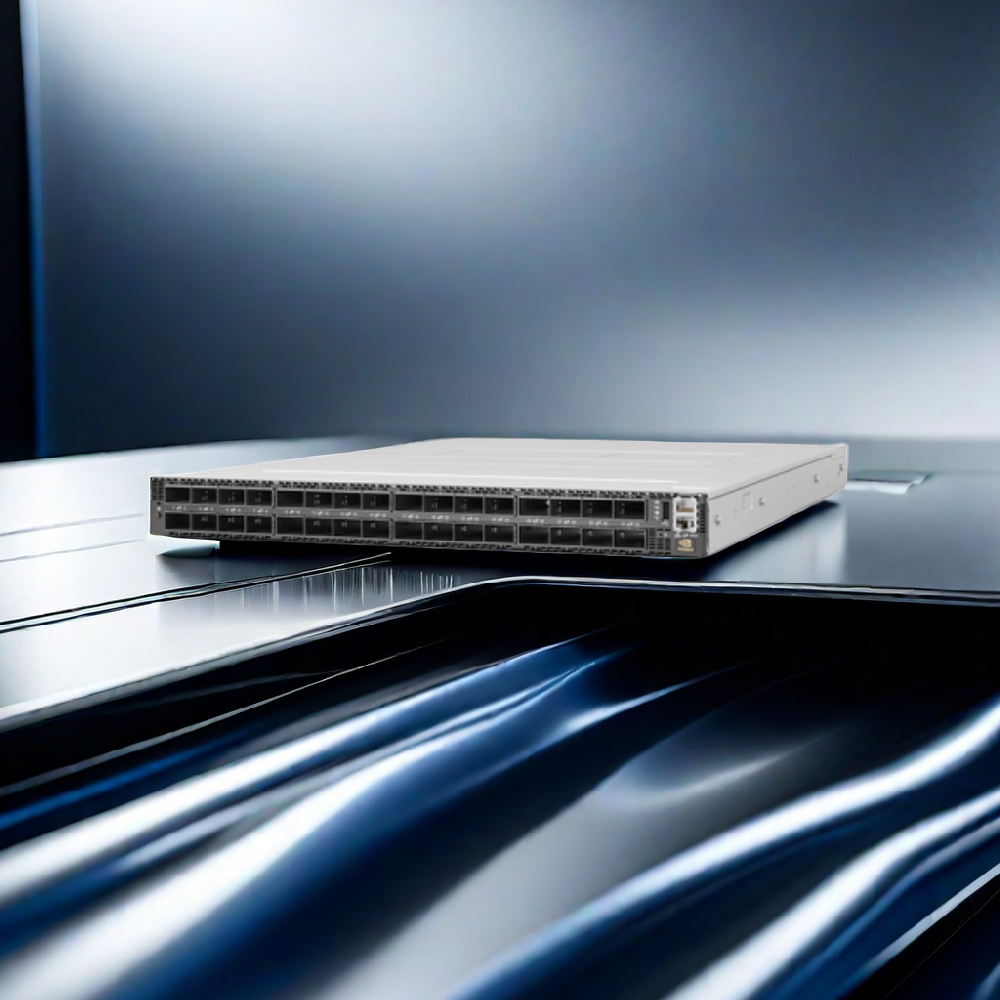
Mellanox-branded 400G switches are relevant when a data center, AI cluster, HPC environment, or storage fabric needs higher per-port bandwidth and an architecture designed to reduce communication bottlenecks. The supplied record associates these platforms with 400Gbps port speeds, low-latency data exchange, RDMA-oriented data paths, and interface options such as QSFP-DD and OSFP. The right choice depends on the complete switch SKU, optics, host adapters, cabling, software stack, and the traffic pattern of the target workload.
What a 400G switch addresses
Growing east-west traffic can make network capacity and latency material constraints in distributed computing environments. AI training requires frequent data exchange among GPU-connected nodes; HPC applications depend on timely node-to-node communication; and NVMe-oF storage deployments place demanding requirements on the network path. A 400G switch can provide up to 400Gbps at a port, according to the source record, creating a higher-bandwidth building block for these designs.
The source also describes optimized switching architecture and RDMA support as mechanisms intended to reduce communication latency and CPU involvement in data transfers. These characteristics should be assessed in the context of the end-to-end fabric, rather than attributed to the switch alone. Congestion behavior, oversubscription, host configuration, storage targets, and application communication patterns can all affect observed results.
Mellanox context and supported capabilities
Mellanox was founded in 1999 and focused on networking interconnect technologies for data centers, cloud computing, AI, and HPC, including InfiniBand and Ethernet solutions. NVIDIA announced its acquisition of Mellanox in 2019. In this context, Mellanox is historical NVIDIA networking branding; this information alone does not establish a present partnership, authorization status, or the specifications of any particular NVIDIA switch.
- 400Gbps port bandwidth: suitable for designs that require high-capacity switch ports.
- Low-latency focus: relevant for workloads sensitive to communication delay, subject to project-level validation.
- RDMA-oriented networking: intended to optimize transfer paths and reduce CPU load in applicable compute and storage environments.
- Optical and cabling flexibility: the source cites QSFP-DD and OSFP among supported connection approaches.
- Modular design considerations: interface and connection choices can support different network topologies, but compatibility must be confirmed for the selected configuration.
Where 400G switching fits
| Scenario | Why it may fit | What to evaluate |
|---|---|---|
| Cloud and data centers | High-throughput network architecture for data-intensive services | Port density, uplink design, traffic growth, and failure domains |
| AI training clusters | High-volume data exchange between compute nodes | GPU-node connectivity, fabric topology, congestion control, and workload communication patterns |
| HPC clusters | Bandwidth and latency are relevant to inter-node communication | Application scaling behavior, host adapters, and fabric management requirements |
| NVMe-oF storage networks | Storage traffic can benefit from an efficient network path | End-to-end protocol support, storage target performance, and resilience design |
Evaluation path before procurement
- Define the workload: identify required bandwidth, latency sensitivity, node count, storage traffic, and expected growth.
- Select the fabric approach: confirm whether Ethernet or InfiniBand is appropriate for the application and operational model.
- Build a complete bill of materials: include exact switch SKU, port licenses where applicable, transceivers or cables, host adapters, rails, power requirements, and management components.
- Confirm interoperability: validate QSFP-DD or OSFP choices, breakout requirements, software versions, and compatibility across switches, NICs, and optics in dated official documentation.
- Run a representative proof of concept: measure throughput, latency, congestion handling, and application behavior under expected workloads and failure conditions.
FAQ
Does a 400G port guarantee better AI training performance?
No. The source identifies AI training as a relevant use case, but it does not provide benchmark results. Training performance must be tested across the complete GPU, host, network, storage, and software environment. Network topology and collective communication behavior are particularly important.
Can QSFP-DD and OSFP be treated as interchangeable?
No. The source identifies both as connection options, not as universally interchangeable components. Verify the exact switch port form factor, supported optical modules or cables, breakout configuration, reach, and host-side compatibility in the dated documentation for the selected SKU.
Conclusion
Mellanox-branded 400G switching is a potential building block for high-bandwidth AI, HPC, cloud, and storage fabrics. Its value should be evaluated through a complete configuration review and a project test that reflects actual traffic, topology, and operational requirements.
After reviewing Mellanox 400G Switches for AI, HPC, and Data Center Networks, continue with NVIDIA products and networking solutions for related evaluation paths.

 WeChat
 Profile