
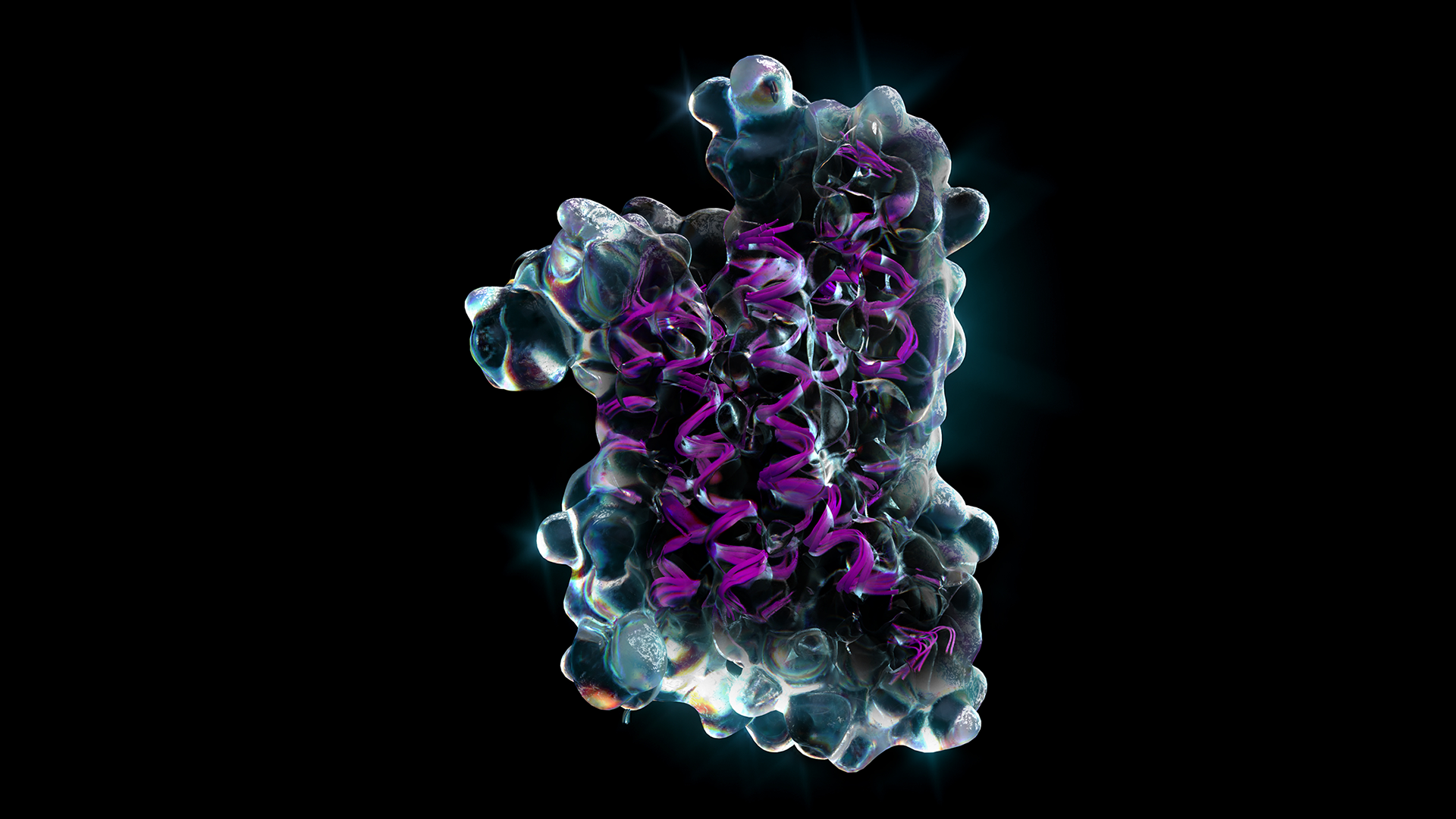
MMseqs2-GPU is designed to shorten the multiple sequence alignment (MSA) stage that can constrain protein structure prediction workflows. The source describes a CUDA-accelerated implementation of MMseqs2 that performs protein-sequence prefiltering and alignment on NVIDIA GPUs. For teams using MSA-informed structure prediction, including ColabFold-based workflows, it offers a path to evaluate faster sequence-database searches while retaining validation of results in the intended scientific workflow.
Why MSA generation matters for protein prediction
An MSA compares a query protein sequence with related sequences from a reference database. The resulting alignment can reveal evolutionary conservation, support analysis of functional residues, and provide inputs for machine-learning methods used in protein structure prediction.
Searching large and growing protein-sequence databases is computationally demanding. Conventional CPU-oriented approaches can be limited when many sequences must be compared in parallel. This makes the MSA stage an important evaluation point for research groups processing large query sets, running iterative searches, or seeking to reduce time spent preparing inputs for downstream structure models.
What MMseqs2-GPU supports
The implementation described in the source replaces the MMseqs2 k-mer prefilter with a GPU-oriented ungapped prefilter. Rather than using a coarse k-mer representation during this step, the approach compares complete sequences with a modified Smith-Waterman-Gotoh method that considers diagonal dependencies and avoids gaps. Top candidates can then proceed to accelerated affine-gap Smith-Waterman-Gotoh alignment.
CUDA kernels support parallel comparison work across GPU cores, with techniques described in the source including shared-memory access, packed 16-bit values, and warp-level processing. MMseqs2-GPU also supports multi-GPU execution, allowing workloads to be distributed when dataset size or throughput requirements exceed a single-GPU configuration.
| Area | Source-described capability | What to verify |
|---|---|---|
| Sequence search | GPU-accelerated ungapped prefiltering and gapped alignment | Database format, query volume, sensitivity settings, and software version |
| Structure prediction input | Integration context with ColabFold workflows | Compatibility with the selected ColabFold or AlphaFold2 deployment |
| Scaling | Multi-GPU workload distribution | GPU topology, host memory, storage throughput, and scheduler configuration |
Reported performance context and suitable scenarios
The source reports that, in a benchmark aligning 6,370 protein sequences against a 30-million-sequence reference database, MMseqs2-GPU on one NVIDIA L40S was 177 times faster than a standard JackHMMER implementation on a 128-core CPU system. It also reports a 720-times result using eight NVIDIA L40 GPUs, with 0.117 seconds per sequence under that test setup.
For a ColabFold workflow using MMseqs2-GPU, the source reports a 22-times faster protein-folding workflow than an AlphaFold2 workflow using JackHMMER and HHblits. The cited comparison used 20 CASP14 queries on a system with 128 CPU cores, 1 TB RAM, 2 TB NVMe storage, and one NVIDIA L40S GPU; the reported accuracy measure was approximately 0.76 LDDT for both methods. These results are benchmark-specific, not a guarantee for another database, model configuration, sequence length distribution, or infrastructure environment.
Potential evaluation scenarios include high-throughput structure-prediction queues, protein family analysis, large-scale proteomic or genomic research, and workflows that need repeated MSA generation. The source also states that MMseqs2-GPU supports profile searching, which may be relevant where iterative profile searches are part of a structure-prediction process.
Evaluation path and operational limits
- Define a representative query set that reflects sequence lengths, organism coverage, and target throughput.
- Run the existing MSA workflow and the MMseqs2-GPU workflow against the same dated reference database.
- Compare elapsed time, GPU memory use, host-memory use, storage activity, alignment sensitivity, and downstream prediction quality.
- Test single-GPU and multi-GPU configurations separately before extrapolating capacity or cost assumptions.
- Confirm supported GPU architectures, installation requirements, software releases, database preparation steps, and license terms in dated official MMseqs2 and workflow documentation.
The source describes lower memory requirements than CPU implementations that rely on large k-mer hash-table indexes, but it does not establish a universal memory figure for every deployment. It also does not provide complete hardware compatibility, cloud pricing, database licensing, or operational support details. Those factors require review against the complete SKU or bill of materials, official documentation, and a project-specific test.
FAQ
Can MMseqs2-GPU replace every AlphaFold2 search workflow?
No universal replacement claim is established by the source. It describes MMseqs2-GPU in a ColabFold context and reports comparative results against workflows using JackHMMER and HHblits. Teams should validate the exact model, database, search settings, and prediction-quality criteria used in their own environment.
Do the reported speedups apply to all protein datasets?
No. The reported figures depend on the stated benchmark hardware, reference database, query set, and software workflow. Sequence characteristics, database scale, I/O performance, GPU count, and configuration choices can materially change observed performance.
Conclusion
MMseqs2-GPU provides a CUDA-based route to accelerate MSA generation for protein-analysis and structure-prediction workflows. Its strongest fit is an environment where MSA search time is a measured bottleneck and where GPU-based sequence search can be evaluated with controlled datasets, documented software versions, and downstream quality checks.
After reviewing MMseqs2-GPU for Faster AlphaFold2 MSA Generation, continue with NVIDIA products and networking solutions for related evaluation paths.

 WeChat
 Profile