
Stone Ridge Technology (SRT) describes a reservoir-simulation workflow that combines its ECHELON simulator with NVIDIA Modulus on AWS to create full-field surrogate models. The approach is intended for reservoir engineering tasks that require many forward simulations, including history matching, probabilistic forecasting, inverse problems, uncertainty quantification, and field optimization. In the source examples, SRT reports that its surrogate models can evaluate scenarios faster than full-physics forward simulation while retaining useful agreement with the ECHELON reference results.
The reservoir-engineering problem
Energy exploration and reservoir management involve uncertainty in geological parameters, fluid and rock properties, boundary conditions, and observed data. Calibrating reservoir models and optimizing field decisions can therefore require a large number of simulations. This becomes computationally demanding when high-fidelity models contain hundreds of thousands or millions of active grid cells.
Conventional surrogate methods can speed up scenario evaluation, but many are designed for a specific use case and may not generalize to other reservoir problems. A full-field surrogate takes a different approach: it approximates the reservoir state variables over space and time, similarly to a full-physics numerical simulator. If it is sufficiently accurate for the engineering decision, it can support repeated inference without running the complete simulator for every candidate scenario.
Architecture path: ECHELON, Modulus, and AWS
In the SRT workflow, ECHELON provides the full-physics reservoir simulations used to generate training, test, and validation data. The generated datasets are stored in Amazon S3 for scalable retrieval. NVIDIA Modulus is then used through its Python interface to build, train, and fine-tune Physics-ML models that act as full-field surrogates.
SRT uses a Fourier neural operator (FNO) model to create spatiotemporal reservoir surrogates. The stated implementation path is therefore:
- Define the uncertain parameters, operational controls, fixed conditions, and output variables relevant to the engineering question.
- Run ECHELON simulations to produce training, test, and validation cases.
- Store and retrieve the simulation data through Amazon S3.
- Train an FNO-based surrogate in NVIDIA Modulus.
- Compare surrogate predictions with ECHELON results before using the model for broader scenario inference.
AWS provides the cloud environment for flexible on-demand compute resources and the handling of large datasets. The source does not specify instance types, GPU counts, model-training duration, data volumes, or deployment configuration. Those items must be confirmed from the project architecture and dated AWS, SRT, and NVIDIA documentation.
Examples reported by SRT
One example concerns well-placement optimization in a reservoir with fixed but spatially heterogeneous geological properties, including porosity and permeability. The scenario contains four producer wells and one injector well. SRT generated samples by varying producer and injector locations, using 500 samples across training, testing, and validation. Its comparison of water-saturation evolution shows the Modulus-based FNO prediction alongside ECHELON reference results, including field-average pressure, water saturation, and oil saturation.
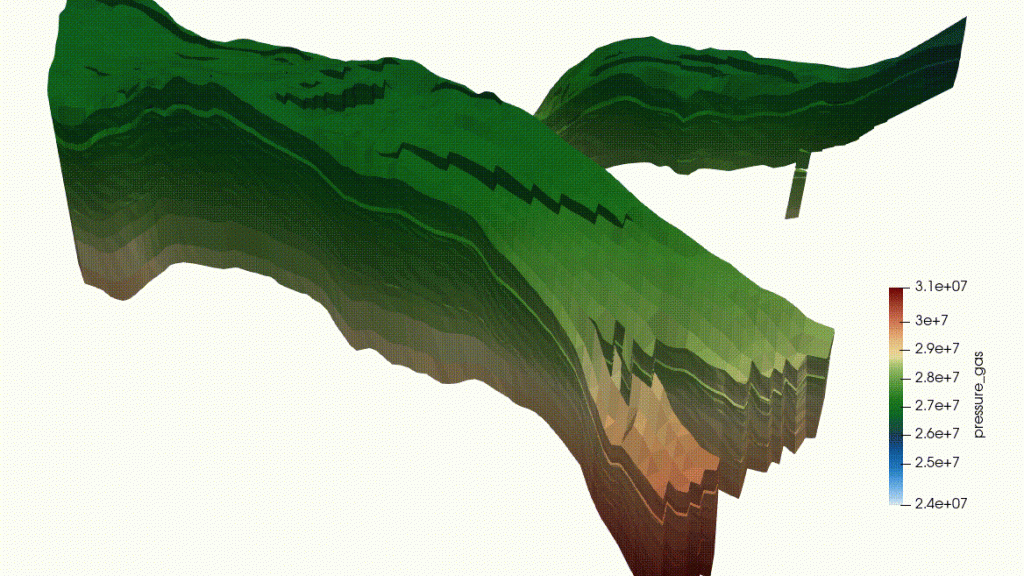
A second example uses a model based on the Norne production area in the Norwegian Sea. The model has a faulted corner-point grid of 46 x 112 x 22 and includes heterogeneous, anisotropic permeability. It contains 35 wells: nine water injectors, four gas injectors, and 22 producers. SRT generated training and test data from 500 realizations that varied geological properties such as porosity, permeability, and fault-transmissibility multipliers. The simulation period was 3,298 days. SRT reports close agreement between FNO and ECHELON for selected pressure and water-saturation results.
Implementation checkpoints and decision limits
The source states that the surrogate models can be 10 to 100 times faster than forward simulation when compared with full-physics numerical solutions. This is an SRT-reported outcome from the described workflow, not a universal performance commitment. Actual speed, accuracy, training cost, and operational value will depend on grid complexity, input variability, required output variables, scenario coverage, hardware, and acceptance criteria.
- Validate against an independently held ECHELON test set that represents the intended decision space.
- Measure error for the variables that govern the decision, such as pressure, saturation, production rates, or well constraints.
- Test conditions outside the training distribution before relying on the surrogate for new well layouts, geological realizations, or control strategies.
- Retain full-physics simulation as the reference for validation and for high-consequence decisions.
- Review the complete model, dataset, software-version, and infrastructure configuration before estimating project cost or timeline.
FAQ
Can this workflow replace every full-physics reservoir simulation?
The source presents ECHELON as both a data generator and a validator for the ML surrogate. That supports using the surrogate for faster scenario evaluation, but it does not establish that full-physics simulation can be eliminated for every engineering decision. The acceptable replacement scope should be determined through project-specific validation.
What use cases are suitable for a full-field surrogate?
The source identifies history matching, probabilistic forecasting, inverse problems, uncertainty quantification, field optimization, and well-placement studies as relevant use cases. Suitability depends on whether the training data covers the geological and operational conditions that the surrogate will be asked to evaluate.
Conclusion
SRT’s AWS-based ECHELON and NVIDIA Modulus workflow provides a path for training full-field FNO surrogates from full-physics reservoir simulations. It is most relevant where repeated reservoir evaluations create a computational bottleneck. Before operational use, teams should verify accuracy, speed, coverage, and infrastructure requirements against their own reservoir model and decision criteria.
After reviewing SRT Reservoir Simulation Workflow with NVIDIA Modulus on AWS, continue with NVIDIA products and networking solutions for related evaluation paths.

 WeChat
 Profile